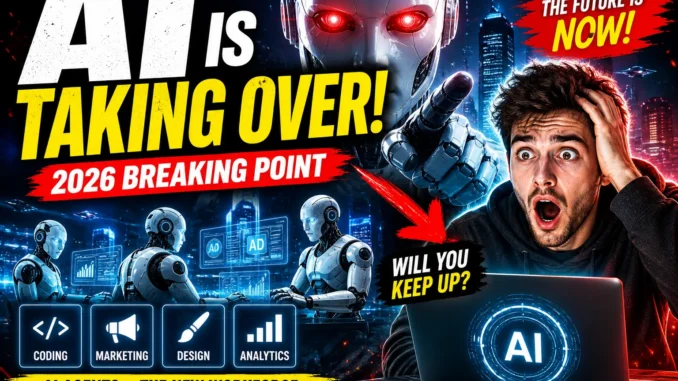
AI Is No Longer Just a tool; it’s becoming a Workforce
Artificial intelligence in 2026 has crossed a critical threshold. What was once a set of tools assisting humans is rapidly evolving into autonomous systems capable of executing complex tasks independently.
The biggest shift?
👉 The emergence of Agentic AI that doesn’t just respond, but acts.
From writing code to running marketing campaigns, AI is no longer passive. It is becoming an active digital workforce.
What Is Agentic AI?
Agentic AI refers to systems that can:
- Understand goals
- Plan multi-step actions
- Execute tasks autonomously
- Adapt based on outcomes
Unlike traditional AI tools, which require constant human prompts, agentic systems operate with minimal supervision.
According to recent research, AI is transitioning from “passive generative tools to systems capable of executing multi-step workflows independently.”
Why Agentic AI Is Exploding in 2026
- From Assistants to Autonomous Workers
Modern AI tools can now:
- Debug entire codebases
- Generate and deploy applications
- Run tests and fix errors automatically
Developers are shifting from writing code to supervising AI agents.
- Multimodal Capabilities Are Accelerating Growth
AI systems now process:
- Text
- Images
- Audio
- Video
This allows tools to perform complex, real-world tasks seamlessly, making them far more powerful than earlier models.
3. Enterprise Adoption Is Scaling Fast
- Financial giants are deploying AI agents for decision-making and analysis
- Creative platforms are integrating AI across entire workflows
- Tech companies report over two-thirds of code now written by AI
This is not experimentation anymore, it’s full-scale adoption.
The Most Important AI Tools Categories in 2026
- General AI Assistants
ChatGPT
Gemini
Claude
These remain the core interface layer for interacting with AI systems.
- AI Coding Agents
Cursor
GitHub Copilot
Claude Code
These tools now act as junior-to-senior developers, handling full project lifecycles.
- Creative AI Platforms
Adobe Firefly
Midjourney
Imagen
They enable end-to-end content creation, from images to videos.
- Automation & Workflow AI
Zapier
Make
AI-native workflow builders
These systems connect apps and automate entire business processes.
- Voice & Media AI
ElevenLabs
Suno
AI now produces human-level voiceovers and music, transforming media production.
The Business Impact: A Shift Bigger Than the Internet
AI in 2026 is no longer about efficiency alone; it’s about redefining work itself.
Key impacts include:
📉 Reduced need for manual labor
⚡ Massive productivity gains
🧠 Shift from execution → supervision
💰 Increased economic value (billions annually)
Companies are reallocating budgets from engineering to distribution and attention because building products is becoming easier than promoting them.
The Hidden Challenge: Control vs Autonomy
Despite its power, agentic AI introduces new risks:
- Reliability issues
- Ethical concerns
- Loss of human oversight
- Data security challenges
Experts warn that widespread adoption depends on balancing autonomy with control systems.
The Future: AI as Your Digital Team
By the end of this decade, the average professional may work alongside:
- AI developers
- AI marketers
- AI analysts
- AI assistants
Not as tools but as collaborative agents.
The future of work is not human vs AI.
It’s human + AI teams.
Conclusion
2026 marks the beginning of a new era:
👉 AI is no longer just generating content
👉 It is executing work
The rise of agentic AI tools is reshaping industries, redefining productivity, and fundamentally changing how businesses operate.
Those who adapt early will gain a massive competitive advantage.
Those who don’t risk being left behind.