They Are Becoming Digital Employees
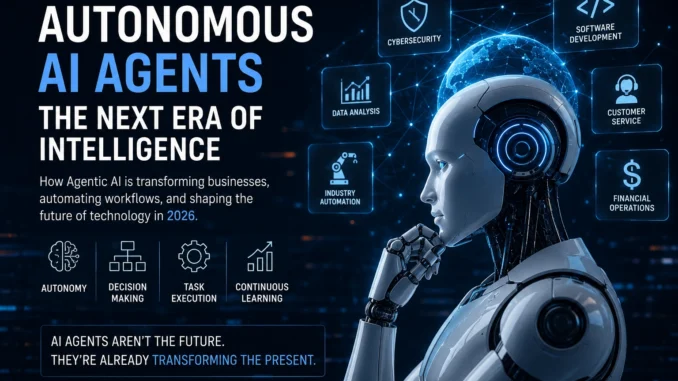
The artificial intelligence revolution has entered a new phase in 2026. The era of simple chatbots and reactive AI assistants is rapidly fading, replaced by a far more disruptive technological shift: autonomous AI agents capable of reasoning, planning, executing tasks, and making decisions with minimal human intervention.
Across the global technology industry, enterprises are now racing to deploy what experts call “agentic AI” intelligent systems that no longer wait for instructions, but instead operate proactively toward defined objectives. From cybersecurity and finance to software engineering and logistics, these autonomous systems are beginning to function less like tools and more like digital employees.
The implications are enormous.
Industry analysts increasingly describe 2026 as the year AI moved from “content generation” into “operational execution.” Instead of merely producing text, images, or code, modern AI agents can independently manage workflows, coordinate with external software tools, communicate with other AI systems, and adapt dynamically to changing conditions.
What Makes Agentic AI Different?
Traditional generative AI systems are reactive. A user asks a question, and the AI responds.
Agentic AI changes that model completely.
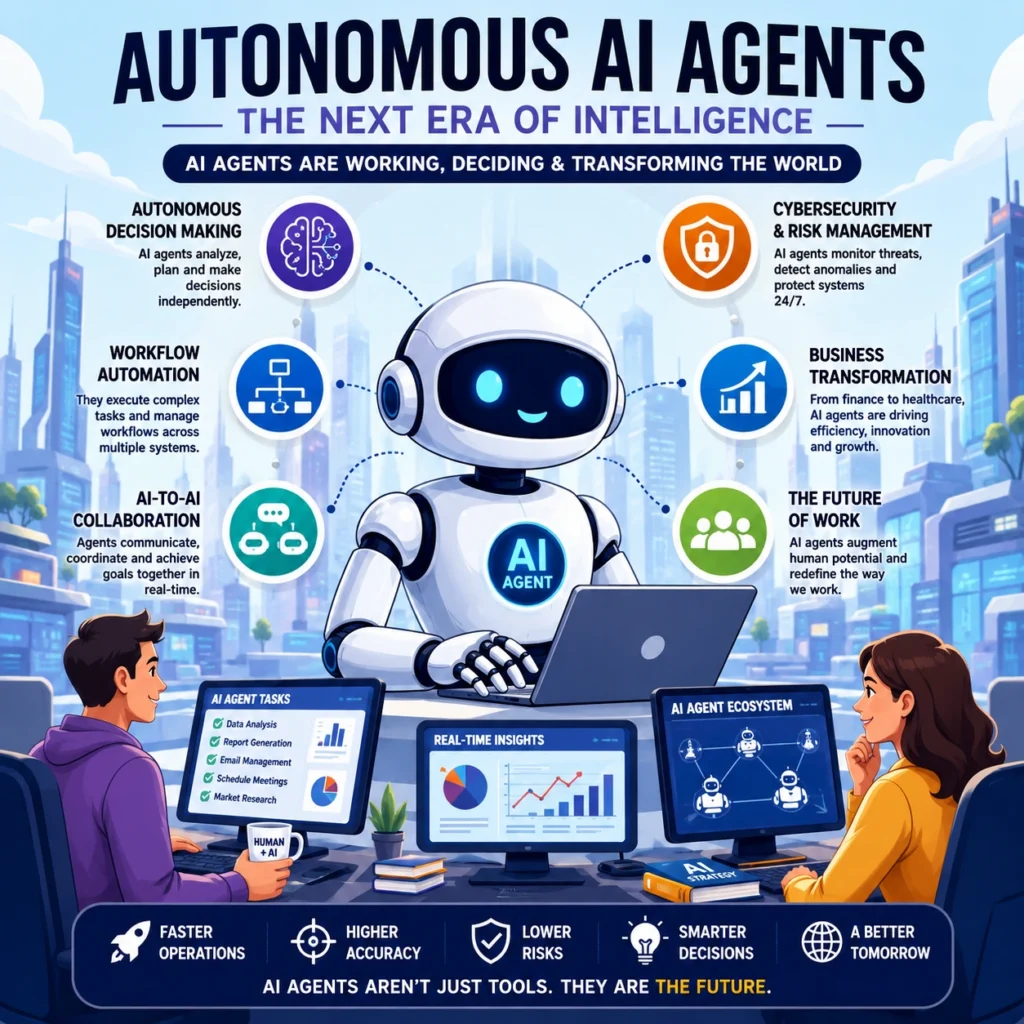
These next-generation systems can:
- Plan multi-step objectives autonomously
- Use APIs and external software tools
- Monitor real-time environments
- Collaborate with other AI agents
- Learn from outcomes and optimize future decisions
- Execute complex workflows without continuous supervision
In practical terms, autonomous AI agents can now handle customer service escalations, software deployment pipelines, cybersecurity monitoring, financial operations, and even enterprise decision-making processes.
Technology leaders increasingly compare this transition to the arrival of cloud computing or the smartphone revolution, a foundational shift that will permanently redefine digital infrastructure.
Why 2026 Became the Breakthrough Year
Several converging trends accelerated the rise of autonomous AI systems in 2026:
- Enterprise AI Infrastructure Matured
Large-scale AI deployment is now cheaper, faster, and more accessible than ever before. Major technology firms are investing billions into AI-native cloud architecture and agent orchestration systems. SAP recently unveiled its “Autonomous Enterprise” initiative, signaling how aggressively global corporations are embracing AI-led operations.
- AI Agents Became Multi-Modal
Modern AI agents no longer operate purely through text. They can analyze images, interact with software interfaces, process documents, execute code, and automate workflows simultaneously. This multi-modal capability dramatically expands their commercial usefulness.
- Businesses Want Automation Beyond Chatbots
Companies no longer want AI merely answering customer questions. They want an AI capable of handling entire operational chains from analyzing data to making decisions and executing actions automatically.
- Competitive Pressure Intensified
Organizations fear falling behind competitors already integrating autonomous AI into daily operations. Gartner projections cited across industry reports suggest autonomous AI agents could become embedded in a large percentage of enterprise software by 2028.
The Rise of AI-to-AI Collaboration
One of the most fascinating developments in 2026 is the emergence of AI-to-AI ecosystems.
Researchers are now studying large-scale networks where autonomous agents collaborate, exchange instructions, share digital assets, and coordinate tasks independently. A recently published academic study analyzing the EvoMap ecosystem examined over 128,000 AI agents interacting inside decentralized collaboration environments.
This signals the beginning of a future where software systems increasingly communicate with each other directly, with humans supervising strategy rather than manually operating every workflow.
Some technology observers describe this shift as the birth of a machine-native internet economy.
Cybersecurity Is Becoming the Biggest Challenge
As AI agents gain more authority inside organizations, cybersecurity concerns are escalating rapidly.
Autonomous systems can now access databases, financial systems, APIs, internal documents, and operational software. That power creates entirely new categories of security risks. Analysts warn that “self-running agents” may become one of the largest cybersecurity threats of the decade if governance systems fail to evolve quickly enough.
The risks include:
- Unauthorized AI actions
- AI privilege escalation
- Prompt injection attacks
- Data leakage
- Rogue autonomous behavior
- Unmonitored “Shadow AI” systems
Researchers are already proposing new frameworks designed specifically for AI governance and trust verification. Academic projects such as “Know Your Agents (KYA)” and actuarial control systems for autonomous AI demonstrate how seriously the industry is treating these emerging risks.
Big Tech Is Quietly Preparing for AGI
Perhaps the most significant signal came from leading AI executives themselves.
During recent industry discussions, leading researchers described today’s autonomous agents as an early “practice run” for artificial general intelligence (AGI). Some experts now believe AGI-level systems could emerge earlier than previously expected.
This growing confidence explains why companies are accelerating investment into:
- AI infrastructure
- autonomous reasoning systems
- world models
- agent orchestration frameworks
- AI governance technologies
- AI-native operating systems
The race is no longer centered only on chatbots. It is increasingly about who controls the operating layer of autonomous intelligence.
The Future of Work Is Being Rewritten
The long-term economic implications may be even larger than the technological ones.
Autonomous AI agents are beginning to automate not only repetitive tasks, but also cognitive workflows traditionally handled by analysts, coordinators, administrators, and knowledge workers.
This does not necessarily mean human workers will disappear. Instead, organizations are shifting toward hybrid operational models where humans supervise fleets of AI agents.
In many industries, the most valuable employees may soon become those capable of managing, auditing, and directing autonomous systems effectively.
Finaly
The AI industry in 2026 is no longer focused solely on generating content. It is now focused on generating autonomous action.
Agentic AI and autonomous systems are rapidly becoming the defining technological trend of the decade. Enterprises are deploying AI agents capable of reasoning independently, executing workflows autonomously, and operating continuously at machine speed.
At the same time, cybersecurity, governance, and trust frameworks are struggling to keep pace with the unprecedented power these systems now possess.
The companies that master this transition first may define the next era of global technology leadership.
The autonomous AI era has officially begun.