For years, Apple faced criticism for being slow in the race to develop artificial intelligence, while other companies quickly launched strong AI assistants and generative AI tools.However, in 2026, this perception has changed a lot.
After making recent announcements and launching new software, Apple has placed Apple Intelligence at the heart of its upcoming product line.
The redesigned Siri is one of the company’s most significant software updates in over a decade.
Instead of focusing on showy AI demos, Apple is taking a different approach.
The company is aiming to make AI part of daily tasks while keeping user privacy as a top priority.
Apple Is Taking a New Approach to AI
Most AI systems today depend a lot on cloud computing.
Apple is using a mix of on-device processing and cloud-based computing.
The new AI system includes:
- – AI running directly on the device
- – Private Cloud Compute for complex tasks
- – Understanding of personal context
- – Deep integration across Apple apps
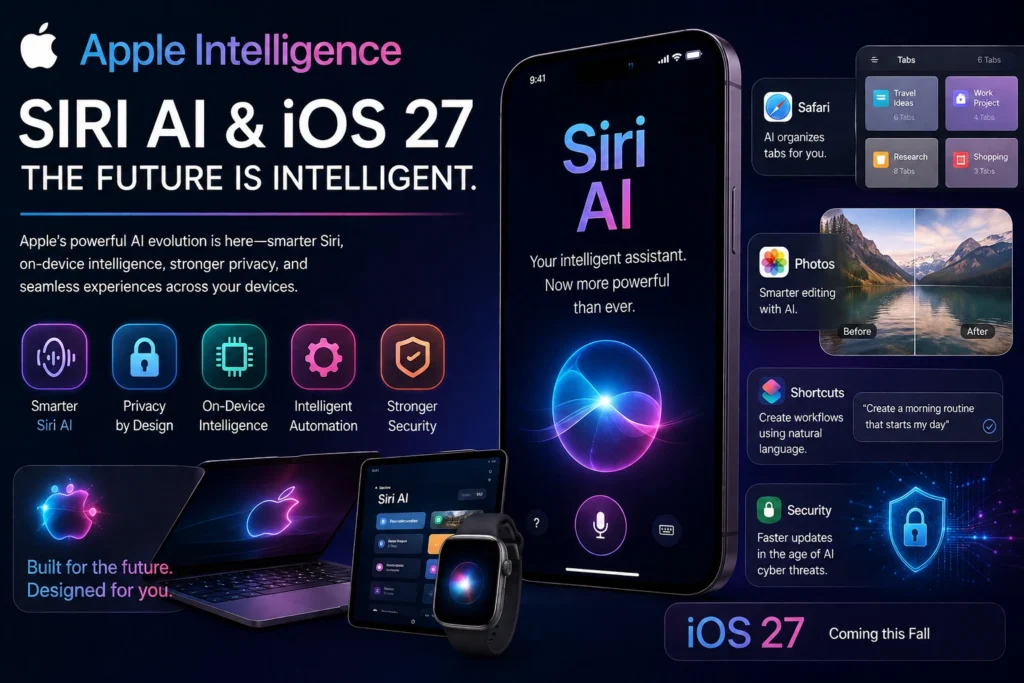
This allows Siri to understand conversations better, recognize what’s on the screen, get information from messages and emails, automate tasks, and carry out multi-step actions with less user input.
Apple claims all these features are built with privacy as a key focus through on-device processing and its Private Cloud Compute system.
Siri Is Becoming a Real Digital Assistant
One of the biggest changes in Apple’s AI efforts is the complete transformation of Siri.
Siri has moved from a basic voice command tool to a conversational AI that can understand natural language, context, and what the user wants.
New features include:
- – Multi-step task handling
- – Screen awareness
- – Understanding personal context
- – More natural conversations
- – Advanced writing help
- – Smart image recognition
- – AI-powered document editing
Instead of opening separate apps for each action, users can simply tell Siri what they want, and it can manage actions across multiple apps.
These features were introduced at WWDC 2026 as part of Apple’s wider Apple Intelligence initiative.
Apple Intelligence is Spread Across the Entire System
Apple’s AI strategy goes beyond just Siri.
Apple Intelligence is now part of the operating system itself.
Major improvements include:
- – Safari: AI automatically groups browser tabs into meaningful categories, making research and project work much easier.
- – Photos: Apple introduced new AI editing tools such as:
- – Enhanced Clean Up
- – Extend
- – Reframe
- These tools help remove unwanted objects, expand image backgrounds, and improve photo composition using generative AI.
- – Shortcuts: Users can now create workflows by simply describing what they want instead of setting up complex automation manually.
- – Messages and Writing: Apple Intelligence helps with:
- – Email drafting
- – Rewriting text
- – Grammar corrections
- – Tone adjustments
- – Smart summarization
Privacy Is Apple’s Most Important Advantage
Unlike many AI services that send user data to remote servers, Apple continues to focus on privacy-first AI.
The company uses:
- – On-device processing
- – Encrypted Private Cloud Compute
- – Minimal cloud exposure
- – Isolation of personal data
Apple argues that users should get powerful AI without giving up their privacy.
This is becoming increasingly important as more people use AI.
Apple Is Speeding Up Security Updates Because of AI
AI is changing cybersecurity just as fast as it is changing consumer apps.
Apple recently changed how it releases software, delivering certain security updates sooner instead of waiting for major OS updates.
The company says this is because AI-powered tools can help cyberattacks happen faster, so it’s important to fix vulnerabilities quicker.
The Foldable iPhone Era is Getting Closer
Beyond software, Apple is preparing for its next big hardware innovation.
Reports suggest Apple is planning to increase production for a high-end foldable iPhone, sometimes called the “iPhone Ultra.” Although the company hasn’t officially confirmed this product, it seems to be aiming for a premium foldable device to compete in the high-end smartphone market.
If these reports are correct, Apple Intelligence could become one of the key features that make future Apple devices stand out.
Why This Matters for Apple’s Future
Apple’s AI plans are not about building another chatbot.
Instead, the company is making intelligence a part of the operating system itself.
This means:
- – Less time spent navigating apps
- – More natural interactions
- – Smarter automation
- – Better productivity
- – Stronger privacy
- – Seamless experiences across iPhone, iPad, Mac, Apple Watch, and Vision devices
Rather than competing only on raw AI power, Apple believes users prefer reliable, private, and deeply integrated intelligence.
Final Thoughts
2026 could be one of the most important years in Apple’s software history.
With the arrival of Siri AI, the expansion of Apple Intelligence, and AI features across nearly every Apple app, the company has moved from being seen as a slow AI follower to becoming a serious contender in the next generation of personal computing.
The real test of Apple’s success won’t be how many AI features it introduces.
It will be how naturally these features become part of daily life, making technology feel like a seamless extension of the user.
For Apple, that has always been the ultimate goal, and 2026 may be the year it finally brings that vision to AI.