For years, Apple has faced criticism for falling behind big names like OpenAI, Google, Anthropic, and Microsoft in the fast-moving world of artificial intelligence.
While these companies kept pushing forward with better AI assistants, Apple stayed focused on privacy, device teamwork, and small improvements.
That situation is now changing.
At WWDC 2026, Apple presented its biggest AI plan yet.
They introduced a totally redesigned Siri and the newest version of Apple Intelligence.Instead of just showing off powerful AI features, Apple is focusing on something that few others can easily copy: smart, personalized AI that works seamlessly across all their devices while keeping user privacy safe.
This isn’t just another software update.
It marks Apple’s biggest investment in AI since the iPhone changed how people use mobile phones.
Apple Rebuilt Siri From the Ground Up
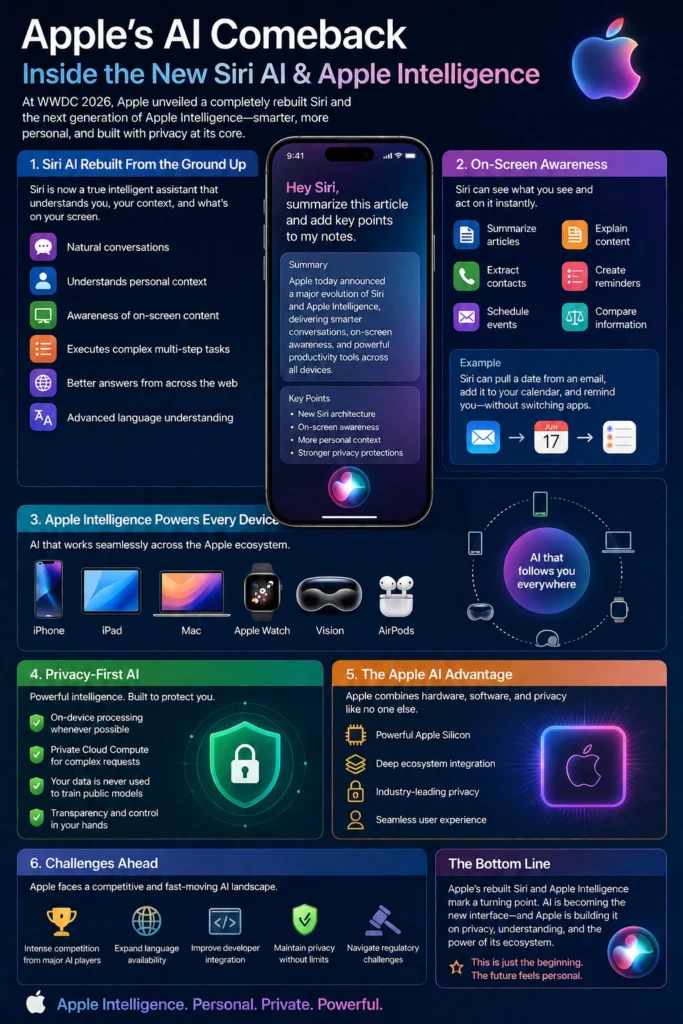
The main part of Apple’s AI plan is the new Siri AI.
Unlike the old Siri, which only handled basic voice commands, the new Siri is like a smart digital friend.
It can understand conversations, keep track of context, and handle tricky multi-step tasks.
Apple has redesigned Siri with several big improvements:
- Natural conversation
- Better understanding of personal habits
- Awareness of what’s on the screen
- Smart task handling between apps
- More accurate web searches
- Stronger language understanding
This means Siri now understands what users are doing instead of just reacting to isolated voice commands.
For example, users can ask Siri to summarize content on the screen, find files from earlier, compare info between apps, or do things that used to need going through several menus.
Apple says this is the start of a more proactive assistant that can predict user needs while keeping privacy secure.
Apple Intelligence Becomes the Foundation of Every Device
Unlike most AI services that rely mostly on the cloud, Apple continues to use a mix of on-device and cloud-based AI.
The latest Apple Intelligence splits AI work between:
- On-device processing
- Private Cloud Compute
- Secure cloud reasoning for tough tasks
This setup lets everyday AI features run directly on iPhones, iPads, and Macs, while only sending complex requests to Apple’s secure cloud servers.
According to Apple, this mix gives:
- Faster responses
- Better security
- Less waiting
- Better personalization
- More power efficiency
This approach fits with Apple’s long-standing belief that users should keep control of their own data.
On-Screen Awareness Changes How People Use Siri
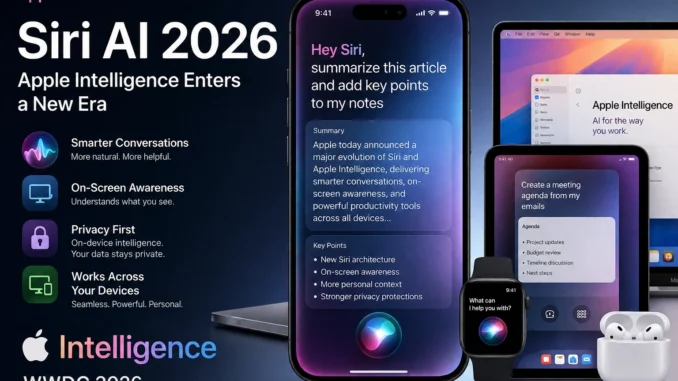
One of the biggest new features is Siri’s ability to know what’s on the screen.
Instead of users having to explain what they’re looking at, Siri can see and act on visible information right away.
Examples include:
- Summarizing long articles
- Explaining unfamiliar topics
- Picking out addresses or phone numbers
- Making reminders from text messages
- Scheduling events from emails
- Comparing products shown on screen
- Finding related documents
This deep understanding makes Siri feel more like a real assistant than just a voice tool.
AI Across the Entire Apple Ecosystem
Apple’s AI vision goes beyond the iPhone.
The company is building Apple Intelligence into:
- iPhone
- iPad
- Mac
- Apple Watch
- Vision devices
- AirPods
This creates an ecosystem where AI follows users smoothly across all their devices.
Tasks started on one device can continue on another, while Siri keeps track of everything during the process.
This ecosystem-first approach is one of Apple’s biggest strengths.
Privacy Remains Apple’s Biggest Differentiator
While many AI companies collect a lot of user data to improve their models, Apple continues to highlight privacy as its key feature.
Apple says:
- Personal requests stay on the device when possible.
- Sensitive info isn’t used for public AI training.
- Private Cloud Compute keeps data safe with strong security.
- Users have more control and transparency over AI processing.
For privacy-focused customers, this could become a big advantage over competitors.
Why This Matters for Apple’s Future
The AI race is no longer just about chatbots.
AI is becoming the main way people interact with technology.
By rebuilding Siri and expanding Apple Intelligence, Apple is trying to change how millions use their devices every day.
Rather than just competing on model size or test scores, Apple is using its strongest strengths:
- Integrated hardware and software
- Strong Apple Silicon chips
- Top privacy architecture
- Good device teamwork
- Smooth user experience
If Apple keeps its promises, Siri could go from one of the most criticized assistants to one of the most useful.
Challenges Still Ahead
Despite the excitement, Apple still faces many challenges.
Competition is strong, with OpenAI, Google, Anthropic, and Microsoft keeping up with quick AI releases.
Apple needs to:
- Offer more languages.
- Deliver promised features on time.
- Improve support for developers.
- Keep privacy without weakening AI abilities.
- Deal with rules in different markets.
The real success of Apple Intelligence will depend on how well it works in the real world, not just what was shown in a keynote.
Final Thoughts
WWDC 2026 might be remembered as the event where Apple fully joined the modern AI era.
The new Siri AI is no longer just a voice assistant—it is becoming a smart layer that helps users, their devices, and their work processes.
With Apple Intelligence, on-device AI, and a strong privacy focus, Apple is standing apart from other major AI companies.
Whether this strategy will let Apple pass competitors is yet to be seen, but one thing is already clear:
Apple is no longer just watching the AI revolution.
It wants to shape the next chapter.