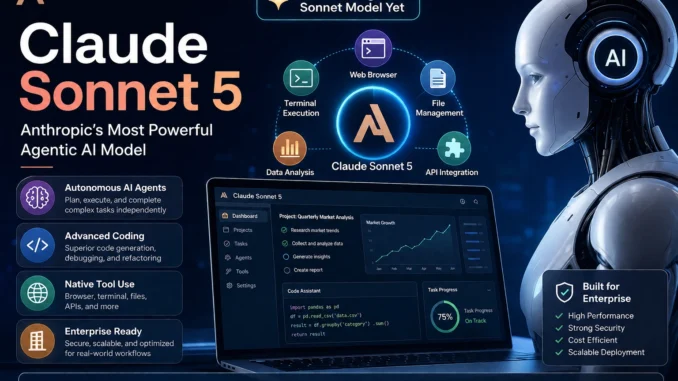
The artificial intelligence industry is moving into a new era. Instead of just competing on how good their chatbots are, top AI companies are now trying to build smart systems that can do real-world tasks on their own. Anthropic’s latest release, Claude Sonnet 5, is a clear example of this change.
Claude Sonnet 5 was launched in late June 2026.
It’s designed to work more like an independent digital worker than just a chat assistant. It has strong reasoning skills, can code well, and can use tools directly. This means it can plan, carry out, and improve complex tasks with little help from humans.
From Chatbots to AI Agents
For a long time, AI assistants mainly answered questions one at a time.
Claude Sonnet 5 shows a big shift in how AI is being used.
Instead of just answering questions, it can:
- – Plan multi-step projects by itself
- – Access websites when allowed
- – Use terminal environments
- – Analyze big data sets
- – Create and edit code
- – Solve software problems
- – Keep working on tasks with little user input
This new “agentic AI” approach allows companies to give more complex tasks to AI instead of just using it for conversations.
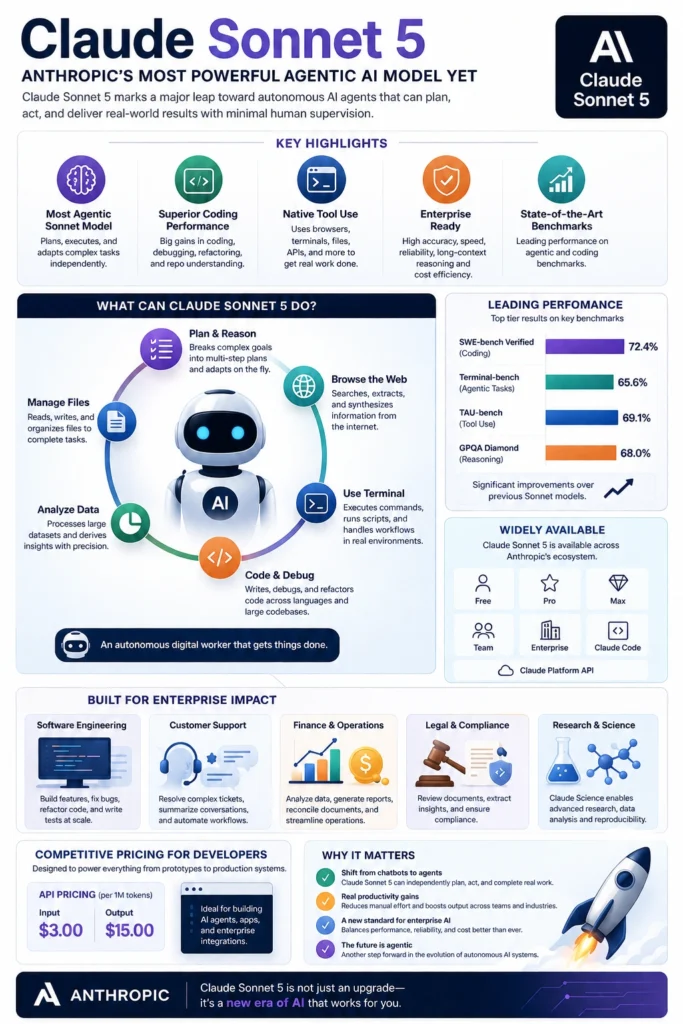
According to Anthropic, Sonnet 5 is the most capable agentic model in their Sonnet series so far.
Major Improvements in Claude Sonnet 5
1.Smarter Autonomous Planning
Claude Sonnet 5 is good at breaking big goals into smaller steps and then carrying them out.
It doesn’t need users to guide every action.
The model can figure out the best way to do things on its own and even adjust when things change.This cuts down on the need for constant instructions and helps knowledge workers be more productive.
2.Powerful Coding Performance
Software development is one of Claude’s strongest areas.
The new model has made improvements in:
- – Writing code
- – Troubleshooting
- – Reorganizing code
- – Understanding code repositories
- – Building large software systems
- – Creating documentation
Anthropic says Sonnet 5 has made big progress in coding and agent-related tests compared to earlier versions, getting closer to the performance of bigger, more powerful models.
3.Native Tool Usage
One of the key features of Sonnet 5 is its ability to use outside tools directly.
Supported tasks include:
- – Browsing the web
- – Running commands in a terminal
- – Managing files
- – Automating processes with APIs
- – Handling multi-step software workflows
This allows the AI to do tasks in real life instead of just telling users what to do.
4.Enterprise-Ready Performance
Anthropic is positioning Sonnet 5 as the go-to model for businesses that want high performance without the high costs of bigger, more powerful models.
The model offers a good balance of:
- – Speed
- – Accuracy
- – Cost efficiency
- – Reliability
- – Ability to handle long conversations
Because of this, it is expected to become the main choice for company use in areas like engineering, customer service, finance, legal, and operations.
Availability and Pricing
Claude Sonnet 5 is available in several versions:
- – Free
- – Pro
- – Max
- – Team
- – Enterprise
- – Claude Code
- – Claude Platform API
Anthropic also introduced pricing for their API that’s meant to encourage more use by developers and businesses.
Why This Launch Matters
The release of Sonnet 5 shows a big change happening in the AI industry.
The competition isn’t just about who has the smartest chatbot anymore.
AI companies are now building systems that can do valuable work without human help.
Modern AI agents are becoming better at:
- – Thinking through problems
- – Planning ahead
- – Using tools
- – Remembering things
- – Writing code
- – Browsing the web
- – Doing tasks step by step
Claude Sonnet 5 is a great example of this shift and puts Anthropic in a strong position in the growing agentic AI market.
Anthropic’s Broader Strategy
Sonnet 5 is part of a bigger plan from Anthropic to create specialized AI platforms.
Along with the model, the company also introduced Claude Science, a special workspace for scientific computing, data analysis, and reliable research.
This shows that Anthropic wants to go beyond general assistants and create AI for specific fields.
The Bigger Picture
Claude Sonnet 5 comes at a time when the AI industry is extremely competitive.
Instead of focusing on making models bigger, Anthropic is focusing on making AI more independent.The goal is to create systems that can reduce repetitive work for developers, scientists, and businesses.
As companies use more AI agents that can handle tasks from start to finish, the competition is changing from being about conversation skills to being about doing real work.
Claude Sonnet 5 shows how fast this change is happening and sets a new standard for AI that’s ready for use in businesses.