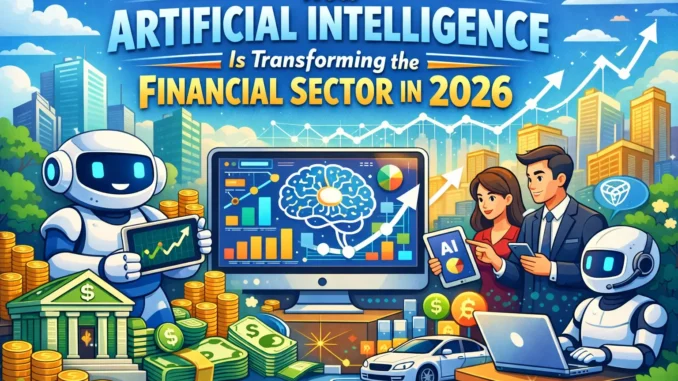
From Autonomous Banking to Real-Time Fraud Detection
Introduction
Artificial Intelligence (AI) is rapidly reshaping the financial industry. What started as experimental machine-learning models in risk analysis has evolved into a powerful ecosystem of autonomous systems, predictive analytics, and generative AI tools that now influence nearly every aspect of banking and financial services.
In 2026, financial institutions are moving beyond pilot projects and integrating AI into their core operations, from credit scoring and trading to compliance and customer service. According to industry forecasts, 90% of financial institutions will deploy at least one AI-enabled technology by 2026, marking a fundamental transformation in how financial systems operate.
This shift is not simply technological; it represents a structural evolution toward what experts call AI-native finance.
The Rise of AI-Native Finance
Financial institutions worldwide are increasingly adopting AI to drive efficiency, reduce risk, and improve customer experiences. Analysts estimate the AI fintech market will grow from $30 billion in 2025 to more than $83 billion by 2030, highlighting the accelerating investment in intelligent financial technologies.
Several recent developments demonstrate how deeply AI is becoming embedded in the financial system:
- Digital banks are investing heavily in AI-driven platforms to scale services and attract new customers.
- Major banking groups are restructuring operations to automate compliance and leverage customer data through AI-powered infrastructure.
- Wealth management firms are acquiring technology platforms to compete in an AI-dominated financial environment.
Together, these developments indicate that finance is transitioning from human-centric operations to hybrid AI-human decision systems.
Key AI Applications Transforming Finance
- Intelligent Fraud Detection
Fraud detection remains one of the most impactful AI use cases in finance. AI systems analyze vast transaction datasets in real time to identify suspicious patterns and anomalies.
Modern machine learning models can:
- Detect unusual transaction behavior instantly
- Reduce false positives in fraud alerts
- Continuously learn from new threats
These systems significantly reduce financial crime while improving trust in digital banking platforms.
- AI-Powered Credit Scoring
Traditional credit scoring relied heavily on static historical data. AI now enables dynamic credit risk modeling by analyzing multiple variables such as transaction history, behavioral data, and economic signals.
Benefits include:
- Faster loan approvals
- More accurate risk assessments
- Greater financial inclusion for underserved borrowers
AI-driven credit analysis allows banks to expand lending while maintaining stronger risk control.
- Algorithmic Trading and Investment Intelligence
AI-powered trading algorithms analyze financial markets, economic indicators, and real-time trading signals to identify profitable opportunities.
These intelligent systems can:
- Execute high-frequency trades
- Forecast market volatility
- Optimize investment portfolios
Financial institutions increasingly rely on these systems to maintain competitiveness in high-speed global markets.
- Generative AI for Customer Experience
Generative AI and large language models are revolutionizing financial customer service.
Banks are deploying AI assistants capable of:
- Handling account inquiries
- Providing financial advice
- Automating onboarding processes
Personalizing financial products
These digital assistants deliver 24/7 support while reducing operational costs, improving both efficiency and customer satisfaction.
The Emergence of Autonomous Financial Systems
One of the most exciting trends in 2026 is the rise of Agentic AI, systems capable of autonomous decision-making.
These systems can:
- Execute trades automatically
- Manage portfolio strategies
- Monitor regulatory compliance
- Detect market risks in real time
Industry experts believe this technology will fundamentally reshape digital banking and wealth management in the coming decade.
Risks and Challenges of AI in Finance
Despite its transformative potential, AI adoption also raises serious challenges.
- Algorithmic Bias
AI systems trained on biased datasets may produce unfair lending decisions or inaccurate risk assessments.
- Regulatory Oversight
Financial regulators worldwide are developing frameworks to monitor AI-driven decision systems and ensure transparency in automated processes.
- Systemic Risk
Researchers warn that if many financial institutions rely on similar AI models, technical failures could spread across the financial system, potentially triggering market instability.
For this reason, AI governance and model risk management are becoming critical components of financial regulation.
The Future of AI in Financial Services
Looking ahead, AI will likely become the backbone of the global financial infrastructure. Industry forecasts suggest that generative AI alone could add hundreds of billions of dollars annually to the banking sector through productivity gains and automation.
Key developments expected in the coming years include:
- Fully autonomous financial advisors
- AI-driven regulatory monitoring systems
- Real-time global payment intelligence
- Hyper-personalized financial products
Ultimately, the financial sector is moving toward intelligent financial ecosystems, where AI continuously analyzes data, predicts risks, and optimizes financial decisions.
Conclusion
Artificial Intelligence is no longer a future concept in finance; it is the engine powering the industry’s transformation. From fraud detection and credit analysis to algorithmic trading and autonomous financial agents, AI is reshaping how money moves through the global economy.
As adoption accelerates, the institutions that successfully integrate AI while maintaining transparency and regulatory compliance will define the next era of financial innovation.
The financial sector of the future will not simply use AI; it will operate through it.