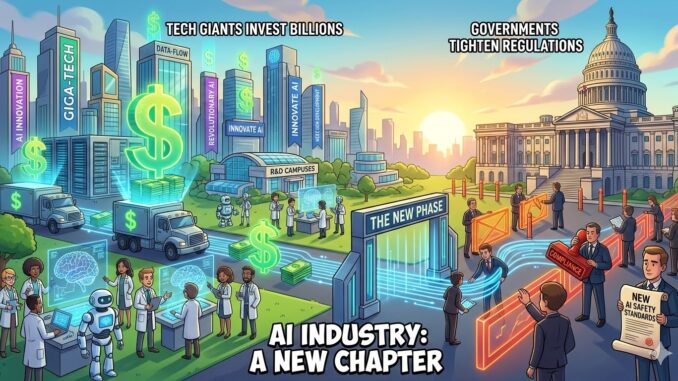
The global artificial intelligence race is accelerating in 2026 as major technology companies invest billions in infrastructure while governments introduce new regulations to control the rapidly expanding industry. Over the past week, several developments, from massive data center investments to geopolitical competition over AI chips have highlighted how AI is reshaping the future of technology, business, and global power.
Artificial intelligence is no longer just a research trend; it has become a strategic technology that influences everything from software development to energy consumption and international trade.
Big Tech Is Spending Billions to Build the AI Future
Technology giants including Google, Microsoft, Amazon, and Meta are investing unprecedented amounts of money into building the infrastructure required for artificial intelligence systems. Analysts estimate that the cost of the global AI buildout could reach trillions of dollars, largely due to the massive data centers and computing power needed to train and run advanced AI models.
These investments are being financed through large corporate debt offerings and long-term capital spending strategies, signaling that big tech companies view artificial intelligence as the most important technological shift since the rise of the internet.
At the same time, companies are racing to develop new models and tools capable of handling complex tasks such as coding, research, and automated decision-making. Industry observers say this marks a transition from experimental AI systems to practical enterprise tools used in everyday business operations.
Governments Are Tightening Control Over AI Technology
While companies are pushing forward with innovation, governments are increasingly concerned about the strategic importance of AI.
Recent reports indicate that the United States is considering stricter rules on exporting advanced AI chips, potentially requiring foreign companies to invest in U.S. manufacturing in order to access the technology.
These policies reflect growing geopolitical competition around artificial intelligence, particularly between the U.S., China, and Europe.
Meanwhile, several countries are also investing heavily in their own AI ecosystems. Spain recently announced a €100 million initiative to support companies developing AI technologies, aiming to strengthen Europe’s digital sovereignty and reduce reliance on foreign tech giants.
Energy and Infrastructure Are the Next AI Battleground
Another emerging issue in the AI industry is energy consumption.
Large AI models require enormous amounts of electricity to train and operate. To address concerns about rising power demand, several major technology companies signed an agreement to cover the cost of electricity generation for their AI data centers, rather than passing the cost to consumers.
This move reflects growing awareness that the AI revolution will require not only better algorithms but also massive energy infrastructure.
The AI Ecosystem Is Expanding Rapidly
The artificial intelligence industry is expanding far beyond traditional tech companies. Startups, research institutions, and governments are all competing to build the next generation of AI technologies.
At the same time, new model releases and developer tools are appearing almost weekly. These tools are increasingly focused on automation, coding assistance, and enterprise productivity, helping businesses integrate AI directly into their workflows.
Experts say the next phase of AI will be defined by specialized AI agents capable of performing complex multi-step tasks autonomously.
What This Means for the Future of Technology
The developments seen in early 2026 suggest that artificial intelligence is entering a new stage of maturity.
Instead of simply launching new chatbots or image generators, companies are now building complete AI ecosystems that include:
- advanced language models
- massive computing infrastructure
- specialized AI applications
- regulatory frameworks
This transformation could fundamentally reshape industries such as software development, healthcare, finance, and education.
However, it also raises important questions about energy consumption, regulation, and global technological competition.
This transformation could fundamentally reshape industries such as software development, healthcare, finance, and education.
However, it also raises important questions about energy consumption, regulation, and global technological competition.
Conclusion
Artificial intelligence is no longer just a fast-growing sector of the technology industry, it is becoming the central platform that will power the next generation of digital innovation.
With billions of dollars being invested, governments introducing new policies, and companies racing to develop more advanced AI systems, the coming years will likely determine which countries and corporations dominate the AI economy.
One thing is certain: the global AI race is only just beginning.