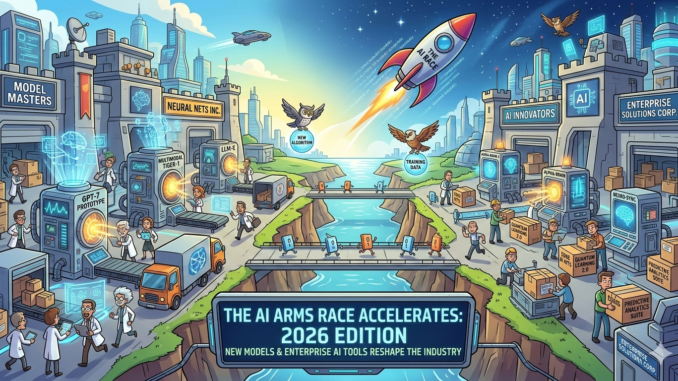
The global artificial intelligence race is accelerating rapidly in 2026 as technology companies push out increasingly powerful AI models, infrastructure, and enterprise tools. Over the past week alone, multiple announcements across the industry—from new large language models (LLMs) to enterprise AI integrations—have highlighted a significant shift: artificial intelligence is moving from experimental technology into practical, productivity-driven systems.
This transition is reshaping the technology landscape, redefining how businesses develop software, automate workflows, and compete in the digital economy.
The Rise of Next-Generation AI Models
The latest wave of AI innovation is being driven by powerful new model releases and upgrades from leading companies. In early March 2026, OpenAI introduced GPT-5.4, an advanced iteration of its flagship model family designed to deliver improved reasoning, expanded context windows, and higher efficiency for developers and enterprises.
At the same time, competing AI labs and startups—including companies such as DeepSeek and major cloud providers—are preparing their own next-generation models. These systems aim to improve coding assistance, automation capabilities, and multimodal understanding, further intensifying competition across the global AI ecosystem.
The result is an unprecedented pace of innovation in generative AI, with companies releasing new capabilities every few weeks rather than annually.
AI Shifts From Experimentation to Real-World Productivity
Industry analysts note that the AI sector is entering a new phase of maturity. Instead of launching purely experimental tools, technology companies are now focusing on reliability, specialized use cases, and integration into everyday workflows.
This shift is particularly visible in three areas:
- AI Coding Assistants
Developer-focused AI tools are becoming one of the fastest-growing categories in artificial intelligence. AI models can now write, debug, and optimize code, dramatically reducing the time required for software development.
- Enterprise Automation
Organizations are increasingly deploying AI to automate internal processes such as data analysis, document processing, customer support, and decision-making workflows.
- AI-Powered Research and Knowledge Work
Tools like AI research assistants are transforming how professionals gather information, analyze data, and generate insights.
Together, these capabilities are turning AI into what many experts describe as a “digital coworker” rather than just a software tool.
Big Tech Expands AI Ecosystems
The surge in AI development is not limited to model releases. Major technology companies are building entire ecosystems around artificial intelligence.
Recent developments include strategic partnerships between cloud providers and AI labs to integrate advanced AI models directly into enterprise infrastructure. These collaborations aim to make AI deployment easier for businesses while strengthening the competitive positions of major cloud platforms.
At the same time, global tech firms are reorganizing internal teams to accelerate AI development and compete in the rapidly evolving market.
The message is clear: artificial intelligence is now the central battleground for the technology industry.
Why 2026 Could Be a Turning Point for AI
Many analysts believe the current wave of innovation could mark a defining moment for artificial intelligence. AI systems are becoming more capable of reasoning, handling complex tasks, and operating autonomously in professional environments.
Several trends suggest the technology is approaching mainstream adoption:
- Rapid iteration of large language models
- Integration of AI into enterprise platforms
- Increasing developer adoption of AI coding tools
- Expanding cloud infrastructure dedicated to AI workloads
Together, these trends indicate that AI may soon become a foundational layer of the global digital economy.
The Future of Artificial Intelligence
Looking ahead, the competition among AI companies is expected to intensify as organizations race to build more capable models and infrastructure. Upcoming releases from major AI labs—including next-generation models from companies like OpenAI, Google, and others—are likely to push the boundaries of what AI systems can achieve.
For businesses and developers, the implications are profound. Companies that successfully adopt AI tools could gain major productivity advantages, while those that fail to adapt risk falling behind in an increasingly AI-driven economy.
In 2026, artificial intelligence is no longer just a promising technology. It is quickly becoming the core engine powering innovation across industries.