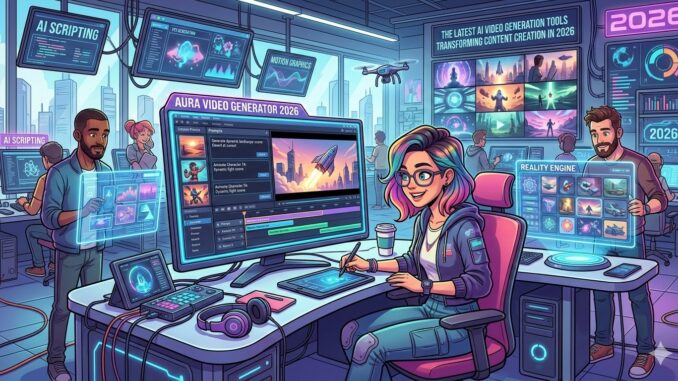
Artificial Intelligence is revolutionizing the video production industry. In recent years, AI video tools have evolved from simple editing assistants into powerful systems capable of generating cinematic videos from text prompts, images, or scripts. These technologies are transforming marketing, filmmaking, education, and digital content creation by dramatically reducing the time, cost, and technical expertise required to produce high-quality videos.
In this article, we explore the latest AI video generation tools in 2026, their key features, and how they are reshaping the future of visual storytelling.
What Are AI Video Generation Tools?
AI video generation tools are software platforms powered by machine learning and generative AI models that can create or modify videos automatically. These tools allow users to generate videos using simple inputs such as:
- Text prompts
- Images
- Audio files
- Scripts or storyboards
Modern AI video systems use diffusion models and transformer architectures to generate realistic motion, scenes, and characters with high visual fidelity.
As a result, creators can now produce professional videos without traditional filming equipment or complex editing software.
Why AI Video Tools Are Growing Rapidly
The popularity of AI video generators is increasing due to several key advantages:
- Faster Content Production
AI can create recordings in minutes instead of days or weeks.
- Reduced Production Costs
Companies can produce marketing videos without expensive production teams.
- Accessibility for Non-Experts
Even beginners can create professional-looking videos with simple prompts.
- Creative Experimentation
AI tools allow creators to explore new visual styles, storytelling formats, and cinematic effects.
These benefits are driving widespread adoption across industries such as digital marketing, social media, e-learning, and entertainment.
Top AI Video Generation Tools in 2026
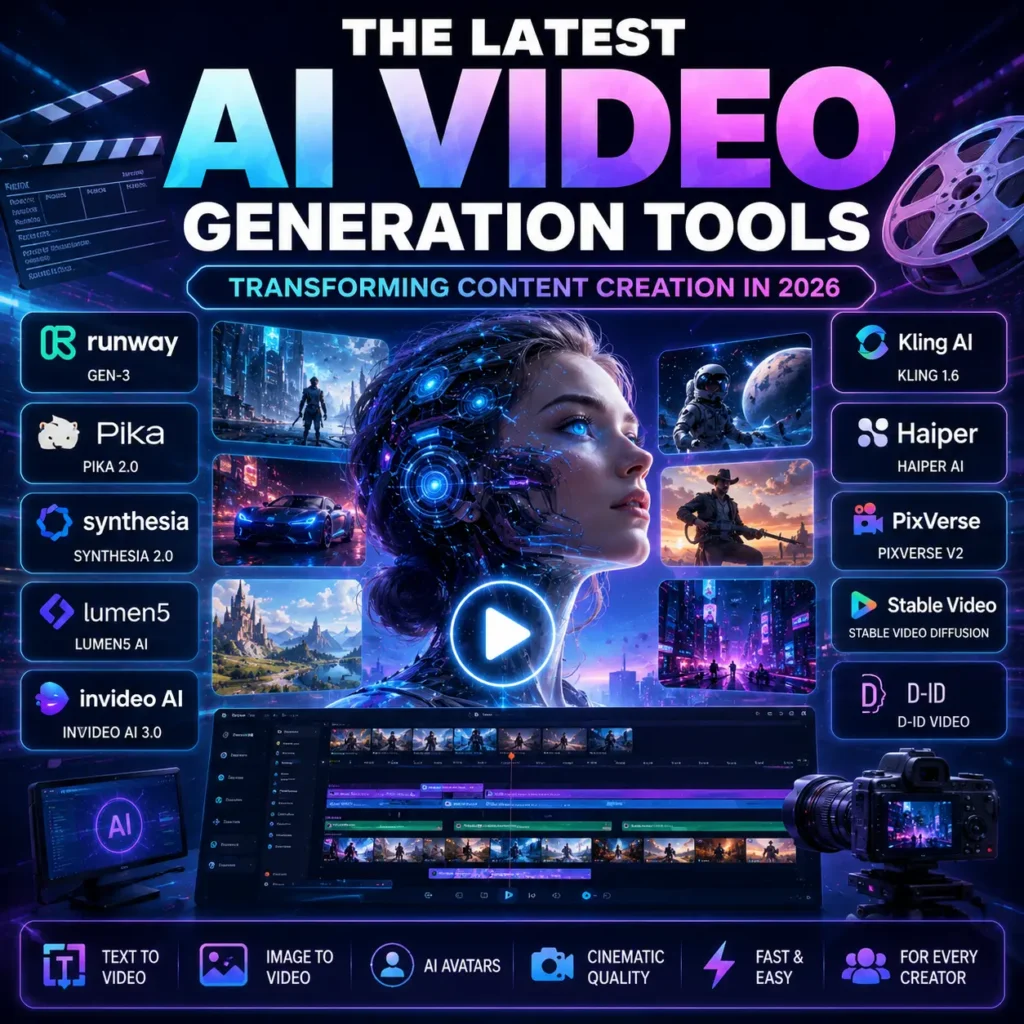
Below are some of the most advanced AI video tools currently shaping the industry.
Runway Gen-4
Runway has become one of the most powerful platforms for AI video generation. Its Gen-4 model allows creators to generate video clips directly from text prompts or reference images.
Key features include:
- Text-to-video and image-to-video generation
- Consistent character identity across multiple scenes
- Advanced cinematic control and scene continuity
- High-quality video output with 4K upscaling options
The model uses advanced diffusion and transformer technologies to generate realistic motion and scene transitions.
Runway is widely used by designers, filmmakers, and marketing teams for creative video production.
Google Veo
Google DeepMind introduced Veo, a powerful AI video model capable of generating high-resolution videos from text prompts.
Notable capabilities include:
- 1080p and 4K video generation
- Realistic physics simulation
- Integrated audio generation
- Longer video durations compared to earlier models
Veo represents a major step toward AI-generated cinematic storytelling.
OpenAI Sora
Sora is one of the most advanced AI video generation models developed by OpenAI. It can generate highly detailed scenes from simple text prompts.
Key advantages:
- Realistic character motion
- Complex scene generation
- Natural physics simulation
- Integration with productivity platforms
Sora has gained significant attention for producing film-quality videos using natural language prompts.
Kling AI
Kling AI is another cutting-edge text-to-video model developed by the Chinese company Kuaishou.
The platform offers:
- Natural language video generation
- Image-to-video animation
- Realistic character movements
- Multiple quality modes
Since its release, Kling has quickly become one of the leading competitors in the AI video generation space.
LTX Studio
LTX Studio focuses on AI-assisted filmmaking workflows rather than simple video generation.
The platform allows creators to:
- Turn scripts into full video storyboards
- Generate scenes and characters
- Control camera angles and framing
- Manage the entire production pipeline
This makes it especially useful for storytelling, filmmaking, and creative agencies.
Emerging Trends in AI Video Generation
Several trends are shaping the future of AI video technology.
- Multimodal Video Creation
New tools can combine text, images, audio, and existing video clips to generate richer content.
- Longer Video Generation
Early AI models could only produce a few seconds of footage. New systems are extending this to minutes of continuous video generation.
- Realistic Physics and Motion
Recent AI models simulate real-world physics, making generated scenes appear more natural.
- Integration with Creative Software
AI video tools are increasingly integrated into design software, editing platforms, and marketing tools.
Challenges and Ethical Considerations
- Copyright and intellectual property concerns
- Potential misuse for deepfakes
- Ethical issues around AI-generated media
Researchers and companies are working on watermarking and detection systems to ensure responsible use of AI-generated videos.
The Future of AI Video Creation
AI video technology is evolving rapidly and is expected to become a core part of digital content production. In the near future, creators may be able to generate full movies, advertisements, and educational videos entirely using AI tools.
As these technologies continue to improve, the line between AI-generated content and traditional filmmaking will become increasingly blurred.
Conclusion
AI video generation tools are transforming the way videos are created. Platforms such as Runway, Veo, Sora, Kling, and LTX Studio are pushing the boundaries of what artificial intelligence can achieve in visual storytelling.
For content creators, marketers, and businesses, adopting AI video technology offers a powerful opportunity to create engaging content faster, more efficiently, and at a lower cost.
The future of video production is clearly being shaped by artificial intelligence.