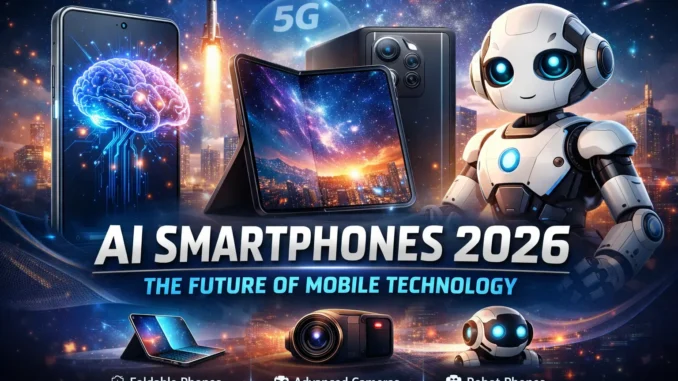
The smartphone industry is undergoing a major transformation in 2026. After years of incremental upgrades, manufacturers are now focusing on artificial intelligence, foldable displays, and revolutionary hardware design to redefine the mobile experience. From experimental “robot phones” to ultra-powerful camera systems and massive batteries, the next generation of smartphones is becoming smarter, more adaptive, and increasingly central to our digital lives.
At global events like Mobile World Congress 2026, companies unveiled devices that demonstrate how smartphones are evolving from simple communication tools into AI-driven personal assistants and portable computing hubs.
AI Smartphones: The Biggest Mobile Trend of 2026
Artificial intelligence is now the core feature of modern smartphones. Instead of relying entirely on cloud processing, many new devices integrate on-device AI chips capable of running advanced tasks directly on the phone.
These AI systems power features such as:
- Real-time language translation
- Smart photography with automatic scene detection
- AI video editing and stabilization
- Predictive battery management
- Intelligent voice assistants that learn user habits
Industry analysts note that smartphone cameras and processors are increasingly designed to enhance AI capabilities directly within the user experience, improving speed, privacy, and efficiency.
For users, this means smartphones are becoming context-aware digital assistants capable of automating daily tasks.
Foldable Phones Go Mainstream
Foldable smartphones have moved beyond being experimental devices. In 2026, they are entering the mainstream market thanks to improved durability, thinner designs, and advanced hinge technology.
Manufacturers are introducing new form factors, including:
Triple-fold designs that expand into tablet-sized displays
Ultra-thin foldable screens with reduced creases
Enhanced multitasking features optimized for large displays
For example, new foldable models revealed recently include devices that unfold twice, creating a 10-inch tablet-like display from a pocket-sized phone.
Market analysts expect foldable smartphones to grow rapidly, with shipments projected to increase by about 30% in 2026 as more brands enter the category.
Camera Technology Is Reaching Professional Levels
Another major innovation driving smartphone competition is advanced camera technology. Modern flagship phones now include:
- Larger image sensors for better low-light photography
- AI-enhanced image processing
- Optical stabilization improvements
- Telescopic zoom lenses
These features allow smartphones to capture cinematic-quality photos and videos, rivaling professional cameras in many situations.
Recent flagship launches, such as the Xiaomi 17 Ultra, focus heavily on camera innovation and imaging performance.
Massive Batteries and Extreme Performance
Battery life has long been one of the biggest concerns for smartphone users. In response, manufacturers are pushing battery technology to new limits.
Recent smartphone launches feature batteries as large as 7,000 mAh, significantly extending daily usage and reducing charging frequency.
Some upcoming models are experimenting with even larger capacities exceeding 10,000 mAh, aiming to deliver multi-day battery performance.
Combined with new chipsets and improved power efficiency, these developments promise a future where smartphones last far longer on a single charge.
The Future: Robot Phones and Intelligent Devices
One of the most futuristic concepts unveiled in 2026 is the AI “Robot Phone.” This experimental device integrates artificial intelligence with physical movement and interactive capabilities, potentially redefining how users interact with smartphones.
Instead of relying solely on touchscreens and voice commands, these devices explore motion-based interaction and embodied AI, creating a more dynamic user experience.
While still in early stages, such innovations signal that the smartphone may soon become an intelligent digital companion rather than just a handheld gadget.
What This Means for Smartphone Users
The rapid evolution of mobile technology in 2026 suggests several key shifts:
- AI will dominate the smartphone experience
- Foldable and multi-screen devices will become more common
- Cameras will continue replacing traditional photography gear
- Battery life will significantly improve
- Smartphones will evolve into fully integrated personal AI assistants
For consumers, this means the next generation of smartphones will be more powerful, intuitive, and versatile than ever before.
Conclusion
The smartphone industry is entering one of its most innovative phases in years. Driven by artificial intelligence, foldable technology, and cutting-edge hardware, modern smartphones are rapidly evolving into intelligent computing platforms that shape how we communicate, work, and create.
As manufacturers race to push the boundaries of mobile innovation, one thing is clear: the smartphone of the future will be smarter, more adaptive, and far more powerful than the devices we use today.