How Intelligent Software Is Transforming Work, Creativity, and the Digital Economy
Artificial intelligence is no longer an experimental technology; it has become a foundational layer of modern software. In 2026, AI tools are rapidly reshaping industries, empowering individuals and organizations to automate complex workflows, generate creative content, and analyze massive datasets in seconds.
From writing assistants and coding copilots to AI video creators and autonomous workflow systems, a new generation of tools is redefining productivity and digital creativity.
The global surge in AI adoption illustrates the scale of this transformation. Studies show that generative AI usage has expanded dramatically in recent years, with younger digital users leading adoption across everyday tasks and professional workflows.
This explosive growth has triggered a global race among technology companies to build the most powerful AI platforms, turning AI tools into the next major productivity revolution.
The AI Tools Boom: A New Software Paradigm
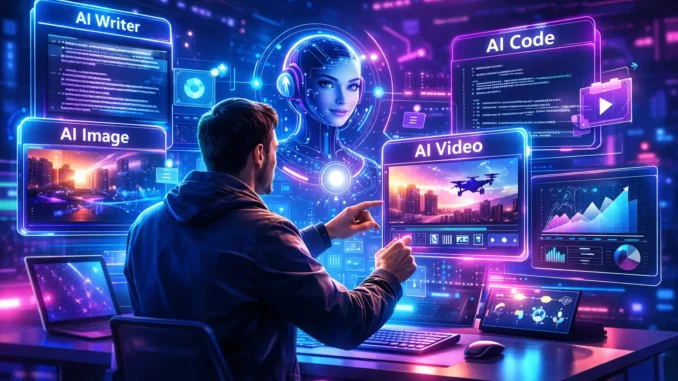
The early wave of AI applications focused primarily on chatbots and simple automation. Today’s AI tools are significantly more advanced. Modern platforms integrate multimodal capabilities, allowing users to generate text, images, code, audio, and video from a single interface.
Many of these tools function as “digital collaborators,” capable of assisting with research, building software, creating marketing campaigns, or producing design assets within minutes.
Leading platforms dominating the AI ecosystem include tools for writing, programming, content creation, and enterprise automation. Popular examples include conversational AI assistants, generative design tools, and workflow automation platforms that streamline complex tasks.
Experts believe this shift represents a fundamental change in how software works. Instead of users navigating menus and commands, AI systems now interpret natural language instructions and execute tasks autonomously.
The Most Influential AI Tools Shaping 2026
A growing ecosystem of AI platforms is defining how individuals and businesses use artificial intelligence. Several categories dominate the market.
- AI Writing and Research Assistants
AI writing tools are among the most widely adopted platforms. These systems help users generate articles, marketing content, emails, reports, and research summaries.
Key capabilities include:
- Automated article generation
- SEO optimization
- Content summarization
- multilingual translation
- research synthesis
These tools are particularly valuable for marketers, bloggers, and researchers who need to produce high-quality content quickly.
- AI Coding Assistants
Software development is another sector experiencing a dramatic transformation.
AI coding assistants can:
- write software functions
- debug errors
- generate documentation
- translate code between programming languages
These platforms dramatically reduce development time, allowing engineers to focus on architecture and problem-solving rather than repetitive coding tasks.
- AI Image and Video Generators
Creative industries are also undergoing a profound shift. AI-powered design tools allow creators to generate high-quality images, videos, and animations from simple prompts.
Generative platforms such as image and video generators enable:
- automated graphic design
- AI video production
- concept art generation
- marketing visuals
- social media content
This technology has already become widely used in filmmaking, marketing, and digital media production.
- AI Productivity Platforms
Another rapidly growing category includes AI productivity tools embedded directly into everyday applications such as document editors, project management software, and note-taking platforms.
These tools help users:
- summarize meetings
- organize projects
- automate workflows
- analyze business data
- generate presentations
This integration allows AI to operate seamlessly inside daily work environments rather than as a standalone application.
The Shift Toward Autonomous AI Systems
The next evolution of AI tools is already emerging: autonomous AI agents.
Unlike traditional tools that wait for instructions, these systems can independently perform complex workflows, such as conducting research, managing digital tasks, or coordinating software systems.
Large technology companies and enterprise consulting firms are investing heavily in this direction, aiming to deploy AI agents across corporate infrastructure to automate entire operational processes.
Industry analysts believe this transition could transform AI from a productivity tool into a fully operational digital workforce.
Why AI Tools Are Growing So Fast
Several factors are accelerating the expansion of AI tools worldwide.
- Explosive Demand for Automation
Businesses are under pressure to reduce costs while increasing productivity. AI tools allow companies to automate repetitive tasks and streamline operations.
- Rapid Model Improvements
Large language models and multimodal AI systems have improved dramatically in reasoning, context understanding, and content generation.
- Integration Into Everyday Software
AI is now embedded directly inside platforms like office suites, creative tools, and development environments, making adoption effortless.
- The Creator Economy
Content creators, marketers, and entrepreneurs are using AI tools to produce videos, articles, graphics, and campaigns at unprecedented speed.
Challenges and Risks
Despite their benefits, AI tools also raise several concerns.
Accuracy and Misinformation
AI-generated content can sometimes contain inaccuracies, requiring human verification.
Job Disruption
Automation may impact certain professions, particularly roles involving repetitive digital tasks.
Infrastructure Complexity
Recent incidents involving AI systems in cloud infrastructure highlight the need for stronger reliability and safety mechanisms in AI deployments.
Balancing innovation with responsible implementation will remain a key challenge for the technology industry.
The Future of AI Tools
Looking ahead, the next generation of AI tools will likely include:
- fully autonomous AI agents
- multimodal creative platforms
- real-time collaborative AI systems
- AI operating systems for businesses
- personal AI assistants managing digital life
Experts widely agree that AI will become a core interface for computing, replacing traditional software workflows with intelligent, conversational systems.
As innovation accelerates, AI tools are poised to become one of the most influential technological shifts of the decade, reshaping how humans work, create, and interact with digital technology.
Conclusion
AI tools in 2026 are more than productivity software; they represent a new computing paradigm.
From automated research assistants to generative video platforms and intelligent coding copilots, these technologies are transforming how individuals and organizations approach work and creativity.
The companies that successfully integrate AI tools into their workflows will gain a significant competitive advantage in the emerging digital economy.
In the coming years, the question will no longer be whether to use AI tools, but rather how effectively they are used.