Autonomous AI Agents Are Replacing the Internet as We Know It
The artificial intelligence industry has entered a new phase, one that goes far beyond chatbots and image generators. In 2026, the global tech race is no longer about who builds the smartest AI model. It is about who builds the most capable autonomous AI agents.
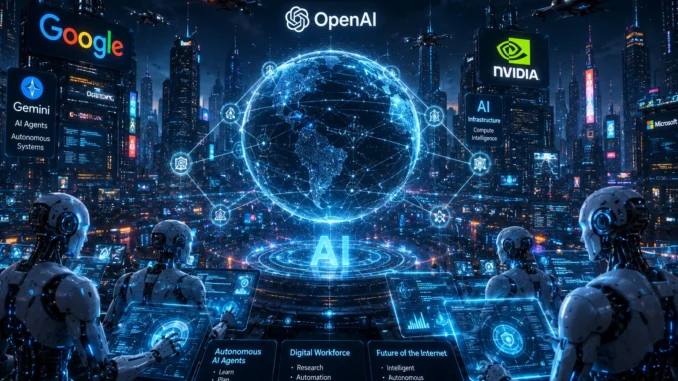
From Google’s next-generation Gemini ecosystem to OpenAI’s agent-powered workflows and NVIDIA’s AI infrastructure dominance, the world’s largest technology companies are rapidly transforming AI into systems that can think, plan, act, and execute tasks independently.
The internet is evolving from a place humans browse manually into an environment increasingly operated by intelligent software agents.
And this transformation may become the biggest technological shift since the smartphone revolution.
Google’s Vision: AI Agents Inside Everything
At the center of this movement is Google, which recently showcased its aggressive AI strategy during its latest developer conference. According to multiple industry reports, Google is deeply integrating AI agents directly into Search, Workspace, Android, and future wearable devices.
Its Gemini-powered systems are no longer limited to answering questions. They are being redesigned to complete actions on behalf of users:
- Drafting emails automatically
- Monitoring inboxes continuously
- Managing schedules
- Conducting research
- Shopping online
- Handling multi-step workflows
One newly revealed concept includes persistent AI assistants that remain active in the background throughout the day, operating more like digital employees than software tools.
Google DeepMind CEO Demis Hassabis described this moment as “the foothills of the singularity,” suggesting humanity is approaching an era where AI systems begin accelerating technological progress themselves.
OpenAI and the Shift Toward Agentic Work
OpenAI is also pushing aggressively into autonomous systems.
The company has expanded beyond conversational AI into full task-oriented agents capable of coding, automation, browser interaction, and enterprise execution. Reports indicate that OpenAI’s ecosystem increasingly focuses on “agentic workflows,” where AI systems can independently perform long-horizon tasks with minimal supervision.
Instead of asking AI for isolated answers, businesses are now deploying AI agents that can:
- Analyze documents
- Generate reports
- Run software tests
- Manage customer support
- Automate internal operations
- Coordinate across multiple applications
Industry analysts believe this transition could redefine knowledge work entirely during the next five years.
Several researchers now describe AI agents as the beginning of an “agentic economy,” where digital labor becomes a measurable economic force alongside human workers and industrial robotics.
NVIDIA Is Building the Infrastructure Behind the AI Revolution
While companies compete to create smarter AI agents, NVIDIA is building the infrastructure powering them all.
Recent developments show NVIDIA expanding far beyond GPUs into specialized systems designed specifically for autonomous AI workloads. One of the company’s newest initiatives includes CPUs and enterprise platforms optimized for large-scale AI agents operating continuously across businesses and cloud environments.
The company’s influence has become so dominant that nearly every major frontier AI lab now relies heavily on NVIDIA hardware for training and deployment.
This growing dependence has turned computing power into one of the most valuable strategic resources in the global AI race.
AI Agents Are Becoming Digital Employees
One of the biggest changes happening in 2026 is the evolution of AI from assistant to operator.
Traditional AI tools waited for instructions. Autonomous AI agents proactively execute goals.
Modern agentic systems can:
- Break tasks into smaller objectives
- Use external tools
- Access APIs
- Navigate websites
- Coordinate with other agents
- Learn from ongoing interactions
- Maintain memory across sessions
Researchers and enterprise leaders increasingly believe every employee may soon supervise a personal team of AI agents specialized for research, scheduling, coding, marketing, analytics, and operations.
This represents a fundamental redesign of digital productivity.
The Internet Is Becoming an “Agentic Web”
Technology experts are now describing the next stage of the internet as the “Agentic Web.”
Instead of humans manually clicking through websites and apps, AI agents will increasingly communicate directly with services, databases, operating systems, and digital platforms on behalf of users.
This shift could transform:
- Search engines
- E-commerce
- Customer support
- Software development
- Online advertising
- Content creation
- Business operations
Some analysts compare this moment to the transition from desktop computing to smartphones, except potentially much larger.
As AI agents become more autonomous, applications themselves may become less important than the intelligent systems controlling them.
Scientists Believe AI Could Accelerate Major Discoveries
Beyond business automation, AI’s impact on science is accelerating rapidly.
According to recent statements from Anthropic leadership, AI may contribute to a Nobel Prize-level scientific breakthrough within the next year.
Meanwhile, new research papers released this month explore advanced autonomous research systems capable of:
- Running experiments
- Writing scientific papers
- Evaluating predictions
- Simulating real-world environments
- Managing complex reasoning workflows
However, researchers also warn that fully autonomous systems still struggle with reliability, hallucinations, and long-term reasoning consistency.
The future may not belong to purely autonomous AI, but rather to hybrid systems where humans supervise increasingly powerful machine collaborators.
The AI Arms Race Is Just Beginning
The competition between Google, OpenAI, Microsoft, Anthropic, and NVIDIA is accelerating at unprecedented speed.
Billions of dollars are flowing into:
- AI infrastructure
- autonomous agents
- robotics
- enterprise AI
- scientific AI systems
- AI-powered operating systems
- intelligent browsers
- agent ecosystems
The next generation of AI is no longer about generating text or images.
It is about building systems that can independently operate inside the digital world.
And in 2026, that future is arriving faster than almost anyone expected.
Finally
The rise of autonomous AI agents marks the beginning of a new technological era.
The companies leading this transformation are not simply building smarter chatbots. They are creating intelligent systems capable of performing work, making decisions, navigating software, and reshaping how humans interact with the internet itself.
Whether this evolution leads to unprecedented productivity or massive disruption remains one of the defining questions of the decade.
But one thing is already clear:
The age of passive AI tools is ending.
The age of autonomous digital agents has begun.