The Internet Is Entering Its Autonomous AI Era
The technology industry is undergoing its biggest transformation since the rise of smartphones and cloud computing. In 2026, artificial intelligence is no longer just a chatbot sitting inside an app; it is becoming the operating layer of the digital world.
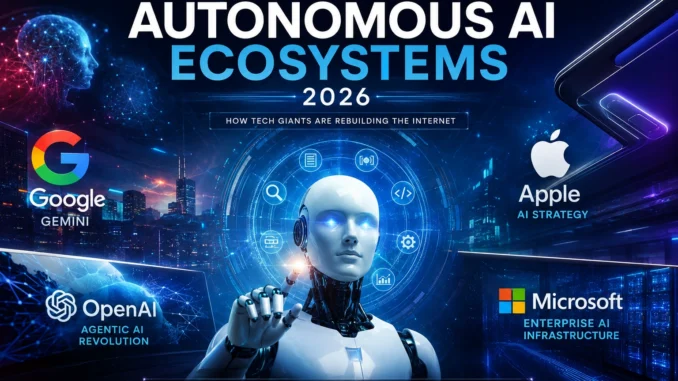
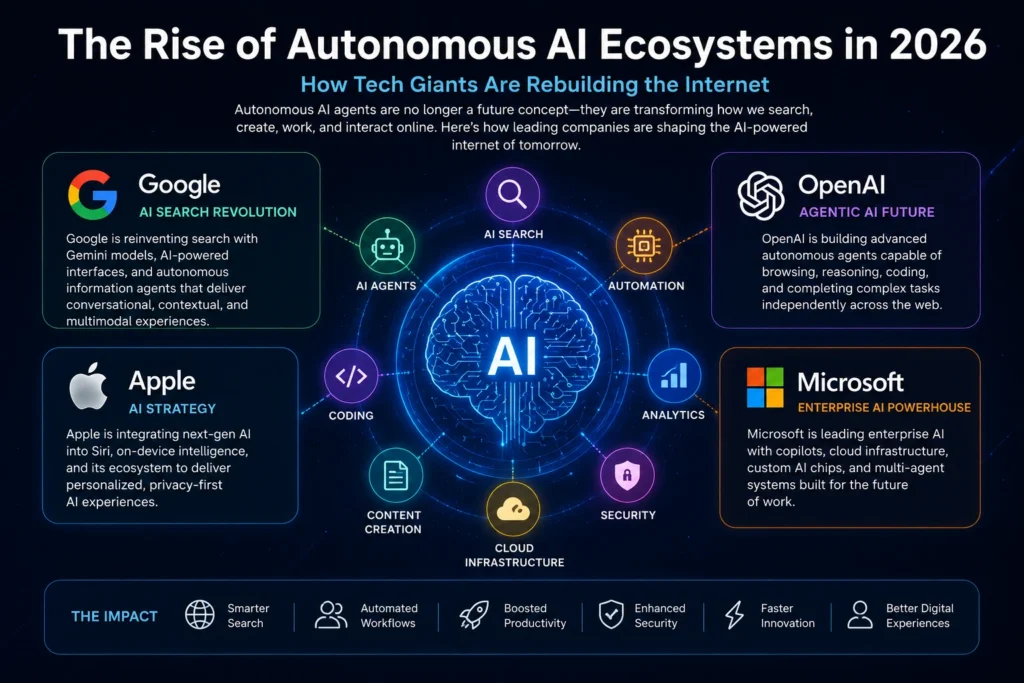
Major technology companies, including Google, OpenAI, Apple, Microsoft, and Meta Platforms, are now racing to build fully autonomous AI ecosystems capable of searching, reasoning, creating, coding, researching, and making decisions on behalf of users.
The shift is redefining how people interact with software, search engines, websites, and even work itself.
According to recent industry reports, AI agents are rapidly moving from experimental tools into production systems across enterprise and consumer technology. Analysts expect agentic AI to become one of the defining technological shifts of the decade.
AI Agents Are Replacing Traditional Software
For years, apps required humans to manually navigate interfaces, click buttons, and execute tasks step by step. The new generation of AI systems works differently.
Modern autonomous agents can:
- Browse websites independently
- Execute workflows
- Write code
- Analyze documents
- Conduct research
- Manage schedules
- Generate media
- Interact with APIs
- Operate software tools autonomously
Industry researchers increasingly describe this transition as the move from “AI assistants” to “AI operators.”
One of the biggest emerging trends in 2026 is the rise of multi-agent systems, networks of specialized AI models collaborating together to solve complex tasks. IBM researchers predict that future AI leadership will depend less on individual models and more on integrated AI systems capable of orchestrating many smaller reasoning engines simultaneously.
Google’s Massive AI Search Revolution
At its 2026 developer conference, Google unveiled what many analysts are calling the biggest transformation to internet search in over two decades.
The company introduced major upgrades to its Gemini ecosystem, including:
- Gemini Omni
- Gemini 3.5 Flash
- AI-powered Search Mode
- Autonomous information agents
- Interactive AI-driven interfaces
Google’s redesigned search experience now behaves more like a conversational operating system than a traditional search engine. Users can upload files, attach browser tabs, ask long-form contextual questions, and receive synthesized AI-generated answers instead of conventional lists of links.
The company is also expanding AI deeper into:
- YouTube
- Android XR
- Workspace
- Shopping
- Wearables
- Smart glasses
This signals a broader strategic shift: the future web may revolve around AI intermediaries rather than direct human browsing.
OpenAI and the New Agentic Computing Race
Meanwhile, OpenAI continues pushing toward autonomous computing systems capable of performing increasingly sophisticated real-world actions.
Reports suggest the company is expanding “agent mode” capabilities that allow AI systems to interact directly with websites and complete tasks independently.
At the same time, the broader AI industry is focusing heavily on:
- Persistent memory systems
- Long-horizon reasoning
- Autonomous planning
- Adaptive agents
- AI browsing environments
New academic research demonstrates that current frontier agents are rapidly improving in long-term adaptation and decision-making tasks, though reliability remains a critical challenge.
Researchers are also developing causal reasoning frameworks that dramatically improve AI reliability inside enterprise systems. Early benchmark studies show major reductions in operational costs and diagnostic time when AI agents operate with structured contextual memory.
Apple’s AI Strategy Is Becoming More Aggressive
After years of cautious positioning, Apple is accelerating its AI ambitions.
Recent reports indicate that Apple’s next-generation Siri ecosystem may integrate advanced AI models from Google’s Gemini platform.
This partnership reflects a major strategic reality in 2026: even the world’s largest technology companies are increasingly dependent on AI infrastructure alliances.
Apple is also investing heavily in:
- On-device AI
- Multimodal intelligence
- AI-enhanced photography
- Voice computing
- Personalized AI assistants
The company’s AI direction suggests future iPhones, wearables, and operating systems will rely on continuously active contextual intelligence rather than isolated voice commands.
Microsoft Is Building the Enterprise AI Backbone
Microsoft remains one of the most influential players in enterprise AI infrastructure.
The company predicts that AI systems in 2026 will evolve into collaborative digital partners that enhance productivity, automate security, accelerate scientific research, and optimize cloud operations.
Microsoft’s strategy increasingly focuses on:
- AI copilots
- Enterprise automation
- AI infrastructure
- Custom AI chips
- Multi-model orchestration
The company is also expanding beyond its historic reliance on OpenAI by deepening relationships with other AI firms, including Anthropic. Reports suggest Anthropic may adopt Microsoft-designed AI chips to reduce dependence on NVIDIA hardware.
This reflects a larger industry trend: AI infrastructure has become one of the most competitive sectors in global technology.
The AI Infrastructure War Is Escalating
Behind every AI breakthrough is an enormous hardware race.
Semiconductor companies are investing billions into AI-focused processors designed for training and deploying large-scale models. AMD recently entered production with next-generation 2nm EPYC processors aimed directly at high-performance AI workloads.
Meanwhile, cloud providers and AI labs are competing to control:
- AI chips
- Data centers
- AI cloud platforms
- Energy-efficient computing
- Specialized inference systems
The battle for AI dominance is increasingly becoming a battle over infrastructure rather than software alone.
Governments Are Struggling to Regulate AI
As AI systems become more autonomous, governments worldwide are facing mounting pressure to regulate the technology.
However, regulatory efforts remain fragmented and politically complex.
Recent reports indicate growing tensions between policymakers and major technology companies over AI safety, national competitiveness, and economic influence.
The challenge is clear:
- Governments want safeguards
- Tech companies want rapid deployment
- Businesses want automation
- Consumers want convenience
- Researchers warn about reliability risks
This conflict is likely to define the next phase of global AI policy.
Why 2026 Could Be the Turning Point for the Internet
The internet was originally built around websites, apps, and human navigation.
But autonomous AI changes the equation completely.
Instead of humans searching for information manually, AI agents increasingly retrieve, summarize, analyze, and execute actions automatically.
This transformation could fundamentally alter:
- Search engines
- E-commerce
- Education
- Media
- Software development
- Digital advertising
- Knowledge work
- Social platforms
Many analysts now believe the future internet will revolve around AI-to-AI interactions rather than human-to-interface interactions.
The result may be the emergence of a fully autonomous digital ecosystem where AI systems continuously operate in the background of everyday life.
Finaly
The AI revolution of 2026 is no longer about simple chatbots or isolated productivity tools.
It is about the creation of autonomous digital ecosystems capable of thinking, coordinating, reasoning, and acting across the internet.
The companies that control these ecosystems may ultimately control the next era of computing itself.
What began as a race to build better AI models is rapidly becoming a race to rebuild the entire structure of the modern internet.