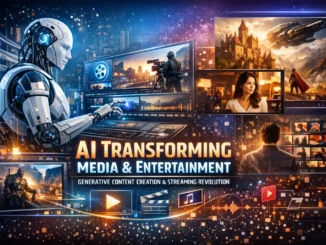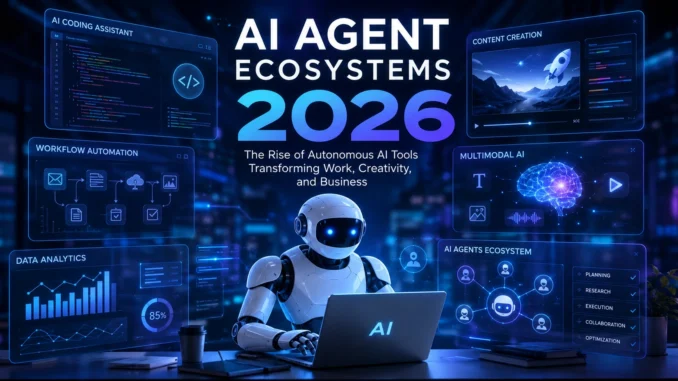
Artificial intelligence is no longer limited to chatbots and content generators. In 2026, the biggest shift in technology is the rise of autonomous AI agents, intelligent systems capable of planning, reasoning, executing tasks, and collaborating across apps without constant human guidance. From AI coding assistants and multimodal content creation to enterprise workflow automation, a new generation of AI tools is redefining productivity and digital experiences.
The latest AI race is no longer about who has the smartest chatbot. It’s about which ecosystem can build the most capable, connected, and reliable AI agents.
The New Era of Agentic AI
Technology leaders now describe 2026 as the beginning of the “agentic AI” era, a transition from AI systems that answer prompts to systems that complete outcomes. Modern AI agents can break complex goals into subtasks, interact with software tools, analyze files, generate media, write code, automate workflows, and continuously adapt in real time.
This evolution is accelerating because of several major breakthroughs:
- Advanced reasoning models
- Multimodal AI capabilities
- Real-time memory systems
- Tool integration protocols
- Autonomous workflow orchestration
- Faster inference infrastructure
The result is a completely new category of AI-powered digital workers.
Why AI Agents Are Becoming the Biggest Technology Trend of 2026
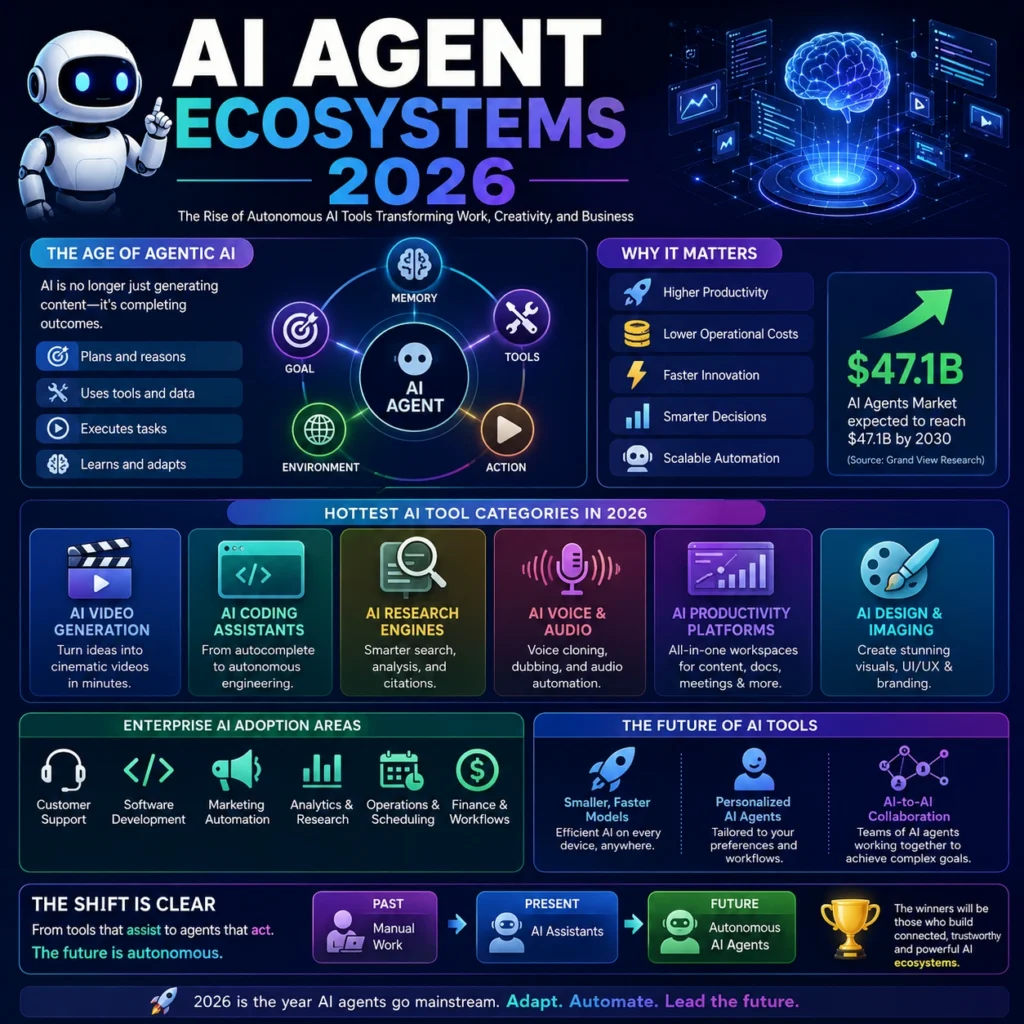
Industry reports show enterprises are rapidly shifting from experimental AI deployments to AI-first operations. Analysts predict that AI agents integrated into enterprise applications will surge dramatically throughout 2026.
Businesses are increasingly deploying AI agents for:
- Customer support automation
- Coding and software development
- Marketing content production
- Research and analytics
- Scheduling and operations
- Financial workflow management
- Sales pipeline optimization
- Internal knowledge retrieval
Unlike early AI assistants, these new systems can act independently with minimal supervision.
The Rise of Multimodal AI Tools
Another defining AI trend of 2026 is the mainstream adoption of multimodal AI systems capable of understanding text, images, audio, video, and structured data simultaneously.
This is transforming how creators, developers, and businesses interact with AI tools.
Instead of switching between multiple apps, users can now:
- Upload screenshots for instant UI generation
- Convert text prompts into cinematic videos
- Generate presentations from research notes
- Create voiceovers automatically
- Analyze documents visually and contextually
- Build software from natural language instructions
Multimodal AI is becoming the foundation of next-generation digital experiences.
AI Coding Tools Are Dominating the Market
One of the fastest-growing sectors in AI is software development automation. AI coding assistants have evolved from autocomplete tools into collaborative engineering agents capable of architecture planning, debugging, testing, and deployment assistance.
According to recent industry analysis, advanced AI coding platforms are now significantly improving developer productivity, especially in enterprise environments.
The most popular AI development ecosystems in 2026 include:
- Anthropic Claude Code
- OpenAI Codex
- Google Gemini development stack
- Cursor AI
- GitHub Copilot
- AI-native IDE platforms
Many startups are now operating with dramatically smaller engineering teams because AI agents handle large portions of repetitive development work.
Google, OpenAI, and Anthropic Are Building AI Operating Systems
The AI competition has evolved beyond individual models into full ecosystem wars.
Major technology companies are now building persistent AI operating systems that connect seamlessly with apps, cloud services, local files, and enterprise infrastructure. Recent launches from Google and enterprise vendors demonstrate how quickly this market is expanding.
Key developments include:
- Persistent AI assistants
- Cross-platform memory systems
- AI workflow orchestration
- Real-time cloud agents
- Collaborative sub-agent frameworks
- Universal AI tool connectivity standards
The emergence of open interoperability standards like MCP (Model Context Protocol) is also making it easier for AI tools to communicate securely across ecosystems.
The Hottest AI Tool Categories in 2026
The AI tools market has exploded into thousands of products across nearly every industry. However, several categories are seeing especially strong growth and viral adoption.
- AI Video Generation
AI video platforms are now capable of producing cinematic-quality content from simple prompts. This has become one of the fastest-growing creator markets online.
- AI Coding Assistants
Autonomous coding agents are transforming software development workflows and startup productivity.
- AI Research Engines
Next-generation AI search and research tools combine web retrieval, reasoning, summarization, and citation systems.
- AI Voice and Audio Tools
Voice cloning, AI dubbing, podcast generation, and synthetic narration tools continue to surge in popularity.
- AI Productivity Platforms
Integrated AI workspaces now combine writing, meetings, presentations, spreadsheets, and automation inside unified ecosystems.
- AI Design and Image Generation
Creative professionals are increasingly using AI for branding, UI/UX design, advertising creatives, and social media content production.
Enterprise AI Is Moving Toward Autonomous Operations
. They are now focused on how quickly they can integrate autonomous systems into operations.
Enterprise AI adoption in 2026 is increasingly centered around:
- AI-native workflow automation
- Governed AI infrastructure
- Secure autonomous agents
- Retrieval-Augmented Generation (RAG)
- AI orchestration frameworks
- Domain-specific AI systems
Many organizations are also prioritizing AI governance, security, and data sovereignty as autonomous systems gain more operational power.
The Future of AI Tools
The next phase of AI innovation will likely focus on three critical areas:
Smaller and Faster Models
Companies are investing heavily in lightweight AI systems that run efficiently on local devices and edge hardware.
Personalized AI Agents
Future AI systems will adapt dynamically to user preferences, workflows, and long-term memory contexts.
AI-to-AI Collaboration
Multiple specialized AI agents working together could become the standard model for complex digital workflows.
This shift may ultimately transform software itself. Instead of manually operating applications, users may simply define goals while AI systems execute the underlying tasks automatically.
Finaly
The AI industry in 2026 is evolving faster than any previous technology cycle. Autonomous agents, multimodal intelligence, AI coding systems, and workflow automation platforms are reshaping how businesses operate and how creators produce content.
The biggest winners in the next phase of AI will not necessarily be the companies with the largest models but the platforms that create the most useful, connected, and trustworthy AI ecosystems.
For businesses, creators, marketers, and developers, adapting to this new AI-first environment is no longer optional. It is becoming a competitive necessity.
Sources & Further Reading
- Business Insider – Inside the AI Coding Wars
- TechRadar – MCP and the Future of AI Interoperability
- TechTarget – The Future of Generative AI Trends