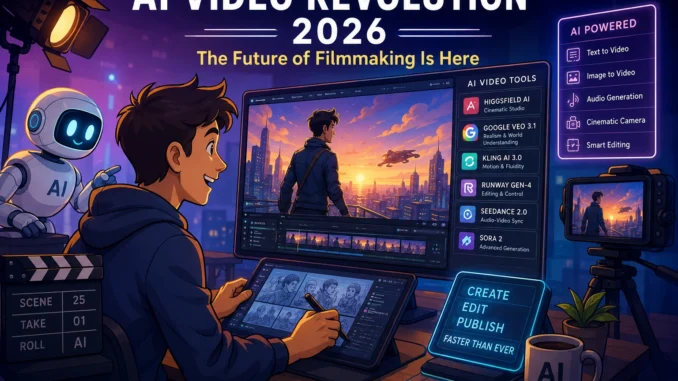
The AI video generation industry has entered a new phase in 2026. What began as experimental text-to-video tools has evolved into a full-scale creative ecosystem capable of producing cinematic advertisements, short films, YouTube content, virtual influencers, and even multi-scene storytelling with synchronized audio.
The biggest shift is no longer just “Can AI generate video?” It is now about creative control, realism, physics accuracy, character consistency, and production speed. Platforms such as Higgsfield AI, Runway, Google Veo, Kling AI, and Seedance are competing to become the operating system for the future of filmmaking.
AI Video Creation in 2026 Is No Longer Experimental
A year ago, creators were impressed when AI could generate a few seconds of motion from a prompt. In 2026, the expectations are radically different.
Modern AI video models now support:
- Cinematic camera movement
- Multi-shot storytelling
- Native audio and lip-sync
- Physics-aware scene generation
- Character persistence across scenes
- Conversational editing
- Image-to-video transformation
- Full advertising workflows
Google’s newly announced Gemini Omni platform represents one of the clearest signs of this transition. The system can generate and edit video from text, images, audio, and existing footage while maintaining scene consistency and contextual understanding.
At the same time, Higgsfield AI has emerged as one of the fastest-growing creative platforms by integrating multiple top-tier AI video engines into one cinematic workspace.
Why Higgsfield AI Is Becoming the Platform Everyone Is Watching
Among all emerging AI video companies, Higgsfield AI has become one of the most talked-about names in the creator economy.
Unlike traditional single-model generators, Higgsfield functions as a unified cinematic production platform. It allows creators to switch between advanced models such as:
- Sora 2
- Kling 3.0
- Veo 3.1
- Seedance 2.0
- WAN 2.7
inside one interface.
Its strongest differentiator is “Cinema Studio,” a production-oriented workflow system that introduces:
- Lens simulation
- Camera choreography
- Motion control
- Character locking
- Scene continuity
- Cinematic aspect ratios
This reflects the broader evolution happening across generative media: AI video is shifting away from novelty and toward professional production infrastructure.
Industry analysts increasingly describe 2026 as the year AI video became a legitimate filmmaking layer rather than a social media gimmick.
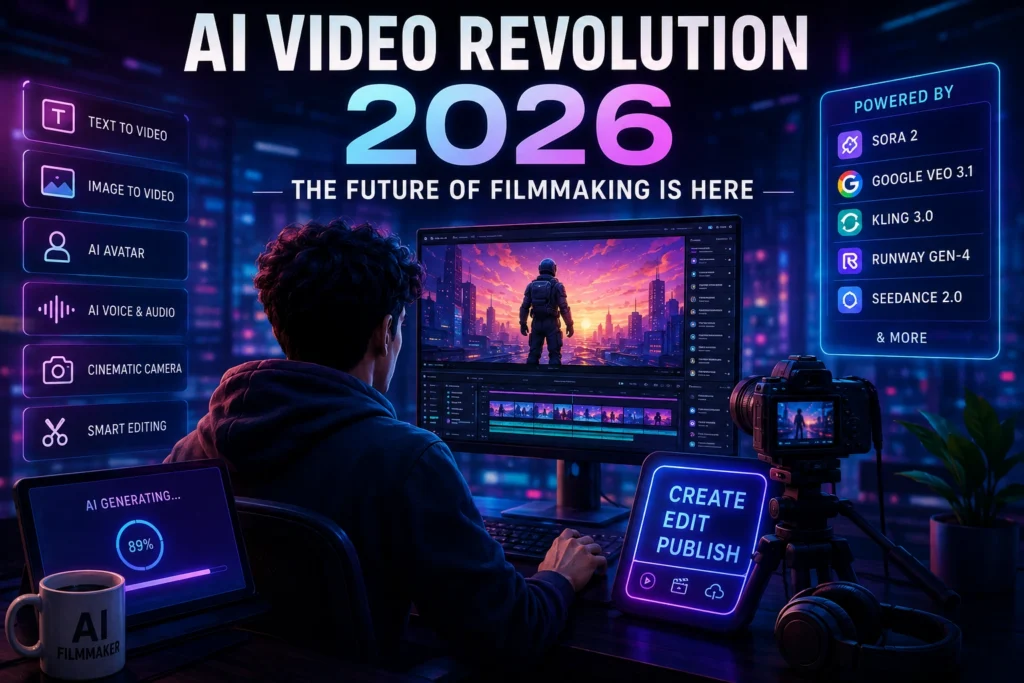
The Biggest Trend: AI Video With Native Audio
One of the most disruptive breakthroughs in 2026 is native audio-video generation.
Older AI systems generated silent clips that required external editing and dubbing. Newer platforms such as Seedance 2.0 and Gemini Omni can create synchronized dialogue, music, sound effects, and lip movement simultaneously.
This drastically reduces post-production time and transforms how creators produce:
- Commercial ads
- TikTok campaigns
- YouTube Shorts
- AI influencers
- Animated storytelling
- Educational videos
The result is a new generation of “one-person studios,” where creators can ideate, generate, edit, and publish cinematic content in hours rather than weeks.
The Rise of AI Filmmaking Ecosystems
Another major shift is the emergence of multi-model creative ecosystems.
Instead of relying on a single generator, creators are increasingly combining several specialized AI systems:
| AI Tool | Primary Strength |
|---|---|
| Google Veo 3.1 | Cinematic realism and world understanding |
| Kling AI | Motion fluidity and social content |
| Runway Gen-4 | Editing workflows and creative control |
| Seedance 2.0 | Native audio-video synchronization |
| Higgsfield AI | Unified cinematic production workflow |
This ecosystem model mirrors professional film pipelines, where different software handles scripting, editing, effects, sound, and rendering.
The difference now is that AI can automate significant portions of the entire process.
Physics-Aware AI Video Is the Next Frontier
Despite massive progress, one major challenge remains: physical realism.
Researchers are now focusing heavily on “physics-faithful” video generation because many AI clips still fail under complex motion scenarios.
New research projects like:
- PhyWorld
- NEWTON
- Aero-World
aim to improve:
- Motion consistency
- Object permanence
- Gravity realism
- Camera continuity
- Physical interaction accuracy
This matters because the future of AI video extends beyond entertainment. These systems could eventually power:
- Robotics simulations
- Virtual training environments
- Digital twins
- Autonomous systems
- Interactive gaming worlds
The Creator Economy Is Being Rebuilt Around AI Video
The commercial impact is already visible.
Brands are now using AI-generated ads to produce campaigns at unprecedented speed and scale. Agencies are replacing traditional production workflows with AI-assisted pipelines for concept development, scene generation, and editing.
At the same time, independent creators are gaining access to cinematic-quality production tools that previously required entire studios.
This democratization may become one of the largest shifts in digital media since the arrival of smartphones and social platforms.
The Ethical Challenge: Can Viewers Still Trust Video?
As AI video realism improves, concerns around misinformation and synthetic media are accelerating.
Google has introduced SynthID watermarking for generated media, while researchers are simultaneously building advanced AI-generated video detection systems.
The industry is now entering a paradoxical era:
AI systems are becoming nearly indistinguishable from real footage
Detection systems are racing to identify synthetic media
This technological arms race is expected to become one of the defining internet challenges of the next decade.
Finaly
The AI video revolution in 2026 is no longer about experimentation. It is about infrastructure.
The platforms leading the market are not simply generating clips; they are building the foundations for a completely new creative economy.
Whether through Google’s Gemini Omni, cinematic systems like Higgsfield AI, or advanced production workflows powered by Runway and Kling AI, the future of content creation is rapidly becoming AI-native.
For creators, marketers, filmmakers, and media companies, the question is no longer whether AI video will transform the industry.
The question is how quickly traditional production pipelines can adapt before the disruption becomes irreversible.