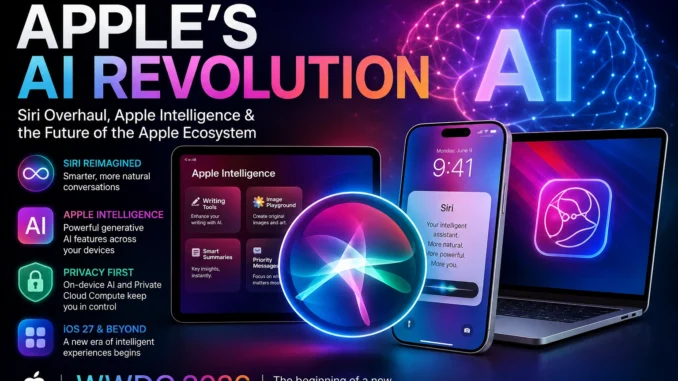
Apple’s AI Moment Has Finally Arrived
For years, Apple watched the artificial intelligence race from a cautious distance while rivals pushed aggressive AI ecosystems into the mainstream. But 2026 may become the year the company changes everything.
Ahead of the highly anticipated WWDC 2026, Apple has quietly signaled a massive shift toward generative AI by registering a new subdomain “genai.apple.com,” strongly suggesting the company is preparing a full-scale AI expansion across its products and services.
This is more than another software update. It could become Apple’s most important strategic transformation since the launch of the iPhone.
Why Apple’s AI Push Matters More Than Ever
The tech industry has entered a new era where AI assistants are evolving into intelligent operating systems. Companies like OpenAI, Google, and Microsoft have aggressively integrated generative AI into search, productivity, operating systems, and consumer devices.
Apple, despite introducing Apple Intelligence in 2024, has often been criticized for moving too slowly in the AI race.
Now the company appears ready to respond.
Reports indicate that Apple’s upcoming AI strategy centers around three major goals:
- Reinventing Siri with modern conversational AI
- Embedding AI deeply across iPhone, iPad, Mac, and Vision products
- Preserving Apple’s privacy-first ecosystem while competing with cloud-based AI rivals
This balancing act may define the future of consumer AI.
The Siri Overhaul Could Be Apple’s Biggest Software Upgrade in Years
The centerpiece of Apple’s 2026 AI strategy is expected to be a dramatically upgraded Siri.
Leaks and industry reports suggest the assistant will finally evolve from a command-based voice tool into a contextual AI companion capable of understanding conversations, on-screen content, app interactions, and user behavior.
Expected capabilities include:
- Natural conversational responses
- Deeper app control
- Cross-device context awareness
- AI-generated summaries
- Intelligent automation
- Smarter voice navigation
- Real-time task execution
Apple is also rumored to be integrating advanced AI models powered partly through a partnership with Google’s Gemini infrastructure.
That partnership alone represents a major strategic shift for Apple, which historically preferred building most technologies internally.
Apple Intelligence Is Expanding Beyond Simple AI Features
When Apple first introduced Apple Intelligence, many users viewed it as a cautious entry into the AI era. But the company’s long-term vision is becoming clearer.
Instead of building a standalone chatbot, Apple appears focused on turning AI into an invisible system-wide layer integrated into every user interaction.
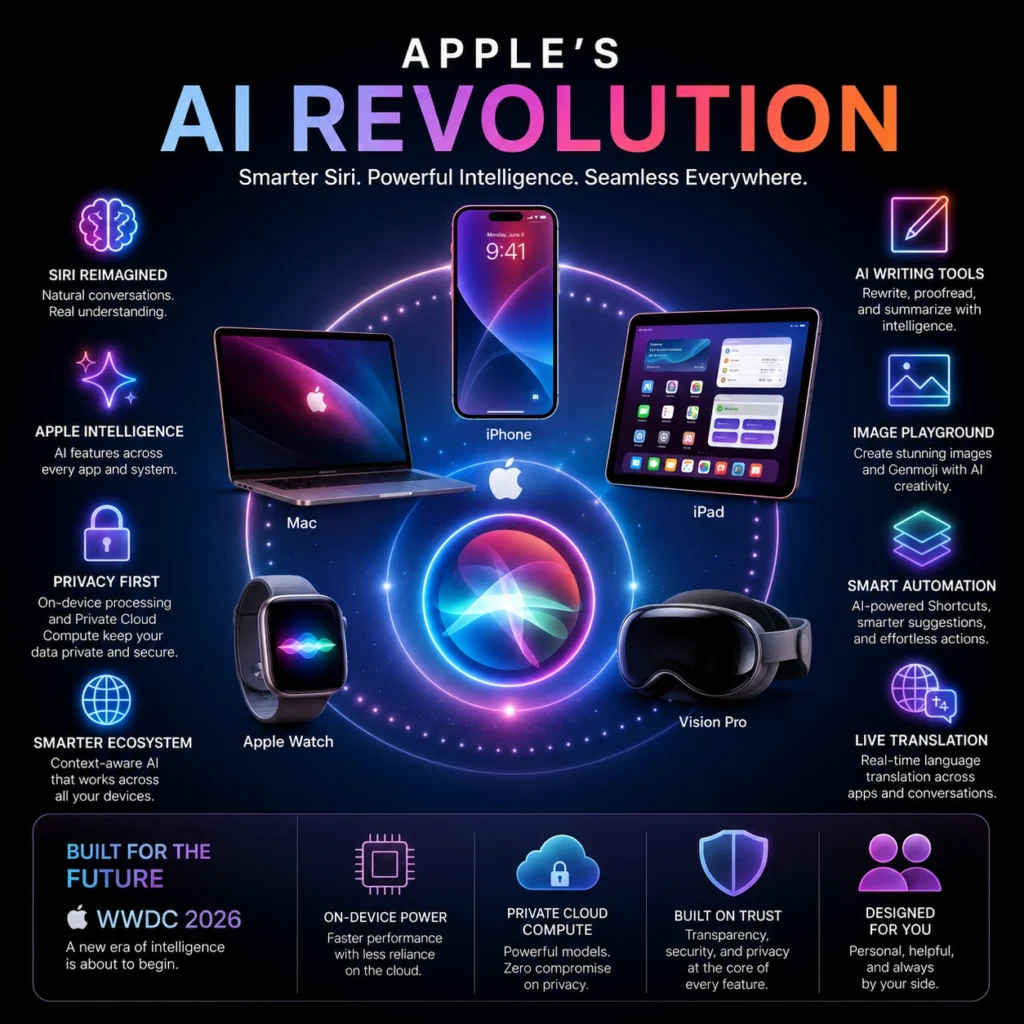
Current and upcoming Apple Intelligence features reportedly include:
- AI writing assistance
- Smart notification summaries
- AI image generation
- Genmoji creation
- Visual Intelligence tools
- AI-powered accessibility features
- Live language translation
- AI-enhanced Shortcuts automation
- Intelligent screenshot analysis
- Context-aware Siri interactions
Apple’s approach prioritizes seamless integration over flashy standalone AI products.
Privacy Could Become Apple’s Biggest AI Advantage
Unlike many AI competitors that rely heavily on cloud processing and massive data collection, Apple continues pushing its “privacy-first AI” philosophy.
Its architecture combines on-device processing with a system called Private Cloud Compute, designed to process sensitive requests without permanently storing user data.
This strategy could become increasingly important as users grow concerned about:
- AI surveillance
- Personal data collection
- Model training transparency
- Biometric privacy
- Cloud-based behavioral tracking
However, recent academic research has also raised questions about parts of Apple’s privacy infrastructure, including differential privacy implementations and cloud verification transparency.
The challenge for Apple is no longer simply building AI; it is building AI users’ trust.
iOS 27 Could Become Apple’s Most Important Operating System Update
Rumors surrounding iOS 27 suggest the update may become one of Apple’s largest software redesigns in years.
Expected upgrades include:
- A redesigned AI-first Siri interface
- Expanded Apple Intelligence integration
- AI-powered accessibility controls
- Improved Image Playground tools
- Advanced voice control systems
- AI automation inside Shortcuts
- Smarter ecosystem synchronization
Apple is also expected to continue expanding its “Liquid Glass” design philosophy introduced with modern OS redesigns.
The result may be an operating system designed not around apps, but around intelligent actions.
WWDC 2026 Could Decide Apple’s AI Future
This year’s WWDC is no longer just another developer conference.
For Apple, it represents a defining moment.
The company must convince developers, consumers, and investors that it can compete in a world increasingly dominated by AI-first ecosystems. Unlike previous technology shifts, the AI race is moving at unprecedented speed.
If Apple succeeds, it could transform the iPhone ecosystem into the most integrated consumer AI platform on Earth.
If it fails, the company risks falling behind competitors that are rapidly reshaping how people search, work, communicate, and create content.
All signs now point toward Apple making its boldest AI move yet.
Finaly
Apple’s next chapter is no longer about smartphones alone. It is about intelligent personal, contextual, and deeply integrated into everyday life.
The emergence of “genai.apple.com” may look like a small technical detail, but in reality, it signals something much larger: Apple is preparing to reposition itself for the AI era.
And WWDC 2026 may become the event where that transformation officially begins.