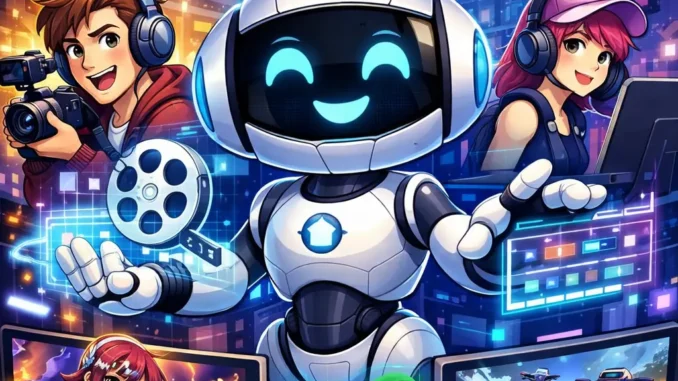
The AI Video Revolution: A New Era for Content Creation
Artificial intelligence is rapidly redefining the future of digital media, and AI video generation tools are now among the most disruptive technologies in the content industry. In 2026, creators can generate cinematic videos, marketing ads, animations, and educational content using nothing more than text prompts.
This shift is transforming industries such as marketing, filmmaking, education, and social media. Instead of traditional video production, which often requires expensive equipment, editing skills, and hours of work, AI video generators can produce realistic clips within minutes.
According to recent technology reports, the AI video ecosystem has grown into a competitive landscape of advanced tools offering high-quality generation, camera control, and realistic motion rendering.
What Are AI Video Generators?
AI video generators are platforms powered by generative artificial intelligence models that convert text prompts, images, or scripts into complete video clips.
These systems use advanced diffusion models, neural networks, and large multimodal datasets to generate visual scenes, characters, lighting, and motion automatically.
Modern AI video tools can:
- Create videos from simple text prompts
- Animate images into motion
- Generate realistic camera movements
- Produce cinematic lighting and visual effects
- Synchronize audio, narration, and lip movements
Some advanced models can generate videos up to 60 seconds long with complex scenes and natural motion, making them suitable for storytelling, marketing campaigns, and social media content.
The Most Powerful AI Video Tools in 2026
The AI video generation market is evolving rapidly, with several platforms competing to deliver the most realistic and controllable outputs.
- OpenAI Sora
One of the most revolutionary AI video models, Sora allows users to generate high-quality cinematic videos directly from text descriptions. It can create complex scenes with multiple characters, realistic physics, and consistent storytelling.
Sora is considered one of the leading benchmarks for text-to-video technology.
Best for:
- Cinematic storytelling
- Realistic scenes
- Creative filmmaking
- Runway Gen-4.5
Runway has become a favorite among filmmakers and professional creators. Its latest models focus on precise camera control, realistic animation, and high visual fidelity.
The platform allows creators to edit videos, generate scenes, and apply AI effects within a single workflow.
Best for:
Professional video production
Marketing videos
AI-assisted editing
- Luma Dream Machine
Luma’s Dream Machine is widely known for its photorealistic video generation and intuitive interface. It allows creators to produce high-resolution videos with advanced motion control and cinematic detail.
Best for:
- Product videos
- Social media content
- realistic visual scenes
- Kling AI and Pika
Tools like Kling and Pika are popular among creators looking for fast, affordable video generation for social media and online content.
They focus on rapid generation, easy prompting, and creative animation styles.
Best for:
- TikTok and YouTube Shorts
- quick visual storytelling
- experimental AI videos
Why AI Video Tools Are Growing So Fast
The explosive growth of AI video tools is driven by several major factors:
- Lower Production Costs
Traditional video production can cost thousands of dollars. AI tools drastically reduce these costs.
- Faster Content Creation
A marketing team can generate multiple video variations within minutes.
- Creative Freedom
Creators can visualize scenes that would normally require expensive sets or special effects.
- Accessibility
AI tools allow individuals and small businesses to produce high-quality content without advanced editing skills.
This rapid innovation is why AI video generation is considered one of the fastest-growing segments of generative AI technology.
How Businesses and Creators Are Using AI Video
AI video technology is already transforming several industries:
Digital Marketing
Brands create product ads, social media videos, and promotional campaigns quickly.
YouTube and Content Creation
Creators generate B-roll footage, animations, and storytelling visuals.
Education
Teachers produce animated explanations and training videos.
Film Production
Studios experiment with AI-generated scenes and pre-visualization.
Even Hollywood is increasingly integrating AI tools into production workflows and post-production pipelines.
Challenges and Ethical Considerations
Despite its benefits, AI video generation also raises important challenges.
Deepfakes and misinformation
Highly realistic AI videos could be misused.
Copyright issues
Training data and creative ownership remain debated topics.
Quality limitations
Some models still struggle with complex physics, long videos, or consistent characters.
As the technology evolves, researchers and companies are working on watermarking, safety controls, and responsible AI frameworks.
The Future of AI Video Creation
Looking ahead, AI video generation is expected to become even more powerful. Future developments may include:
- Real-time video generation
- Full-length AI films
- interactive AI storytelling
- fully automated content production pipelines
Some experimental research models are already capable of generating long videos in real time, suggesting that AI filmmaking may soon become mainstream.
Conclusion
AI video generators are no longer experimental tools; they are becoming essential technologies for modern content creation. Platforms like Sora, Runway, and Luma Dream Machine are redefining how videos are produced, enabling creators and businesses to generate high-quality visual content faster than ever before.
As AI continues to advance, the boundary between imagination and production will become increasingly blurred. The creators who learn to leverage AI video tools today will likely lead the next generation of digital storytelling.