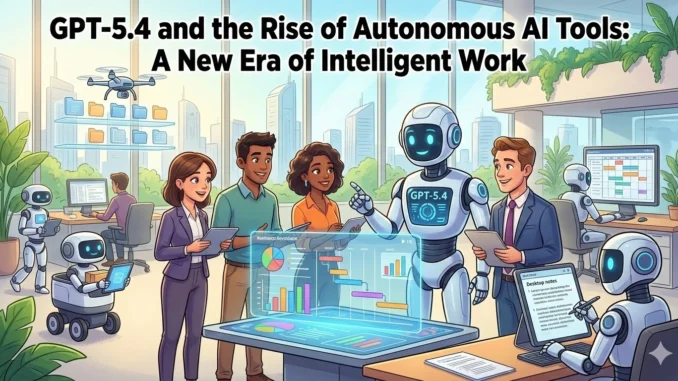
Artificial intelligence is evolving faster than ever, and 2026 is shaping up to be a pivotal year for AI innovation. Major technology companies are releasing increasingly powerful AI tools designed not only to assist humans but also to perform complex tasks independently. One of the most significant recent developments is the launch of GPT-5.4, a new generation AI model that signals a shift toward fully autonomous digital assistants capable of executing real-world tasks.
This rapid evolution of AI tools is transforming industries from software development and research to marketing and enterprise automation making artificial intelligence a central driver of the digital economy.
The Launch of GPT-5.4: A Major Leap in AI Capabilities
The newly released GPT-5.4 represents one of the most advanced AI models developed to date. Designed for professional and enterprise environments, the model introduces improved reasoning, efficiency, and the ability to interact directly with software tools and computer systems.
One of the most notable features is its “computer-use capability,” allowing the AI to interact with applications, analyze complex datasets, and automate tasks such as spreadsheet analysis or workflow management. This functionality enables businesses to delegate multi-step digital tasks to AI systems, reducing manual effort and accelerating productivity.
Another key improvement is efficiency. GPT-5.4 reportedly requires significantly fewer computational resources for certain tasks while supporting extremely large context windows. This allows the model to analyze massive documents, datasets, or entire projects within a single session.
The Rise of Autonomous AI Agents
Beyond individual models, the broader trend shaping the AI landscape is the emergence of autonomous AI agents systems capable of planning, executing, and completing tasks with minimal human supervision.
These systems are moving AI from simple conversational assistants toward digital coworkers that can:
- Analyze complex problems
- Plan multi-step workflows
- Interact with external software tools
- Execute tasks automatically
New AI frameworks and platforms are already enabling developers to build such agents, allowing them to handle everything from cybersecurity monitoring to automated research.
For example, some new AI security agents can scan entire codebases, identify vulnerabilities, and even generate patches to fix security flaws automatically something that previously required human engineers.
Competition Intensifies in the AI Industry
The AI race is becoming increasingly competitive as major companies continue releasing new models and tools. Alongside GPT-5.4, other AI developers are introducing new platforms, marketplaces, and advanced chatbot capabilities designed to attract enterprise users and developers.
AI assistants are becoming more personalized. Some platforms are even introducing long-term memory capabilities that allow AI tools to remember user preferences, project contexts, and previous conversations to deliver more accurate results.
This competition is accelerating innovation and expanding the ecosystem of AI tools available to businesses and creators.
What This Means for the Future of Work
The rapid advancement of AI models like GPT-5.4 suggests that the role of artificial intelligence in everyday work will expand dramatically over the next few years.
Experts predict that AI systems will increasingly function as collaborative digital assistants, helping professionals:
- automate repetitive tasks
- analyze large datasets
- generate content and reports
- assist with coding and software development
While concerns remain about job disruption, many analysts believe the technology will ultimately augment human productivity rather than replace workers entirely.
The Next Phase of the AI Revolution
The launch of GPT-5.4 and similar AI tools marks the beginning of a new phase in artificial intelligence development, AI systems can actively participate in digital workflows instead of simply responding to prompts.
As companies continue to invest billions of dollars in AI research, the coming years are likely to bring even more powerful models, smarter AI agents, and deeper integration of artificial intelligence into everyday business operations.
For technology professionals, creators, and entrepreneurs, staying informed about these innovations will be essential in navigating the rapidly evolving AI landscape.