Introduction
The global artificial intelligence race has intensified as major technology companies compete to dominate the next generation of digital experiences. Two of the biggest players, Apple and Google, are now at the center of this competition with their respective AI ecosystems: Apple Intelligence and Google Gemini.
However, a surprising development in 2026 reshaped the landscape. Instead of purely competing, Apple announced a strategic partnership with Google to integrate Gemini models into Siri, marking a significant turning point in the evolution of consumer AI. Apple Intelligence and Google Gemini are now both rivals and collaborators, setting the stage for a new era of AI-powered devices.
This article explores the Apple AI vs Google AI rivalry, their technological approaches, and what this means for the future of smartphones, search, and intelligent assistants.
The Rise of Apple Intelligence
Apple officially introduced Apple Intelligence as its integrated AI framework designed to enhance the experience across iPhone, Mac, and iPad. The system focuses on on-device AI processing, deep system integration, and privacy-first architecture.
Unlike traditional cloud-based AI models, Apple emphasizes running many tasks directly on the device using its specialized hardware, such as the Apple Neural Engine.
Key Features of Apple Intelligence
- On-device AI processing for better privacy
- Intelligent writing tools across apps like Notes and Mail
- AI-powered photo editing and object recognition
- Context-aware Siri assistant
- Deep integration with iOS and macOS ecosystems
Apple’s strategy revolves around a seamless user experience rather than exposing raw AI power, making the technology feel almost invisible to users.
This approach aligns with Apple’s long-standing philosophy: hardware and software integration combined with strong privacy protections.
Google Gemini: The Powerhouse of Multimodal AI
While Apple focuses on integration, Google has taken a different path with Gemini. Google’s AI strategy centers on large-scale multimodal models capable of understanding text, images, audio, and code simultaneously.
Gemini is deeply embedded across the Google ecosystem, including Search, Android, Gmail, Docs, and Chrome.
Key Capabilities of Google Gemini
- Advanced multimodal AI reasoning
- Deep integration with Google Workspace
- AI-powered research and content generation
- Real-time conversation with Gemini Live
- Large-scale cloud infrastructure
Gemini is widely considered one of the most powerful AI assistants for productivity and research tasks, especially for users already operating within Google’s ecosystem.
Google continues to improve the platform rapidly. In 2026, it introduced Gemini 3.1 Flash Lite, designed for faster responses and high-volume AI workloads for developers.
The Game-Changing Partnership: Apple Adopts Gemini for Siri
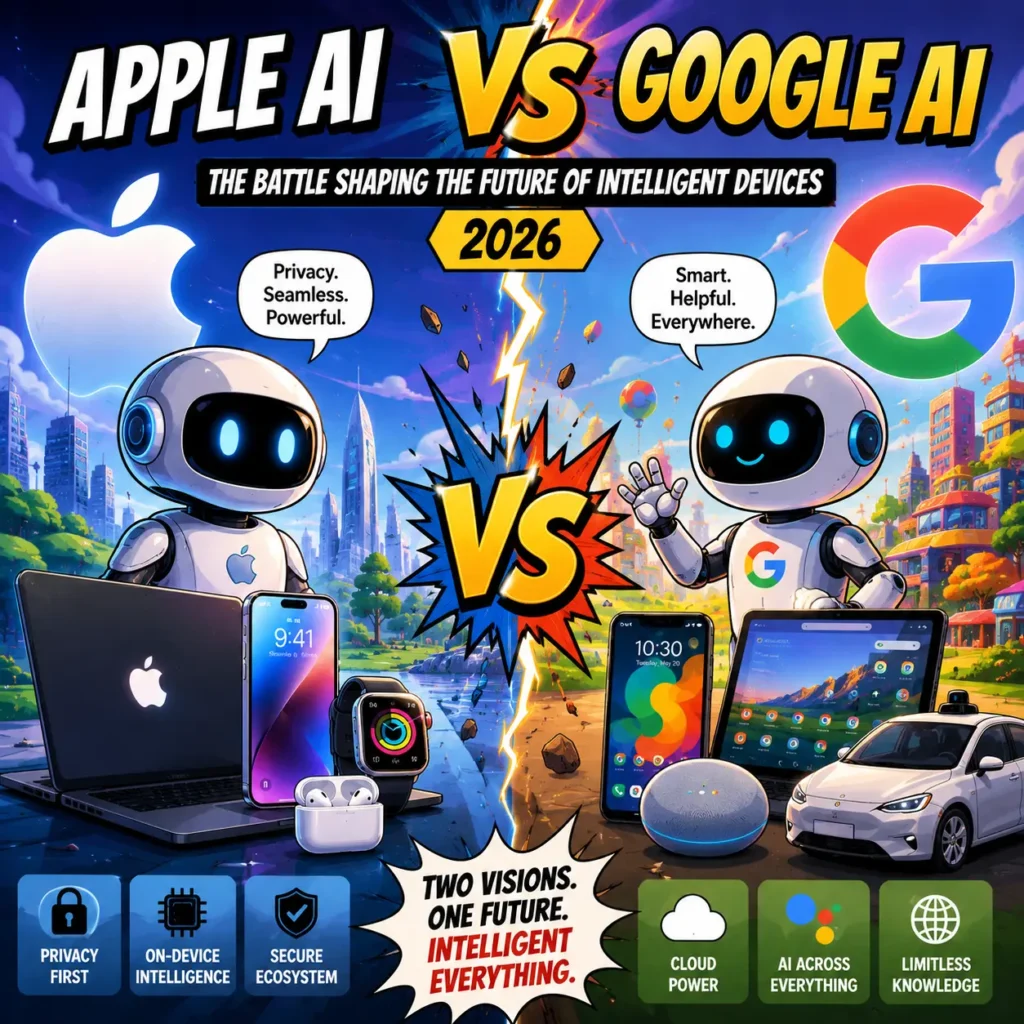
In a surprising strategic shift, Apple announced that a customized version of Google’s Gemini model would help power the next generation of Siri.
Reports indicate the agreement could cost Apple roughly $1 billion annually, highlighting how critical AI has become in the tech industry.
The upgraded Siri will leverage Gemini’s advanced language capabilities while running on Apple’s secure infrastructure. This hybrid approach allows Apple to maintain privacy standards while benefiting from Google’s leading AI research.
The collaboration is expected to deliver:
- More conversational Siri interactions
- Faster contextual search results
- AI-generated summaries and planning assistance
- improved natural language understanding
Industry analysts see this partnership as a major turning point in the AI race, proving that even tech giants may collaborate to accelerate innovation.
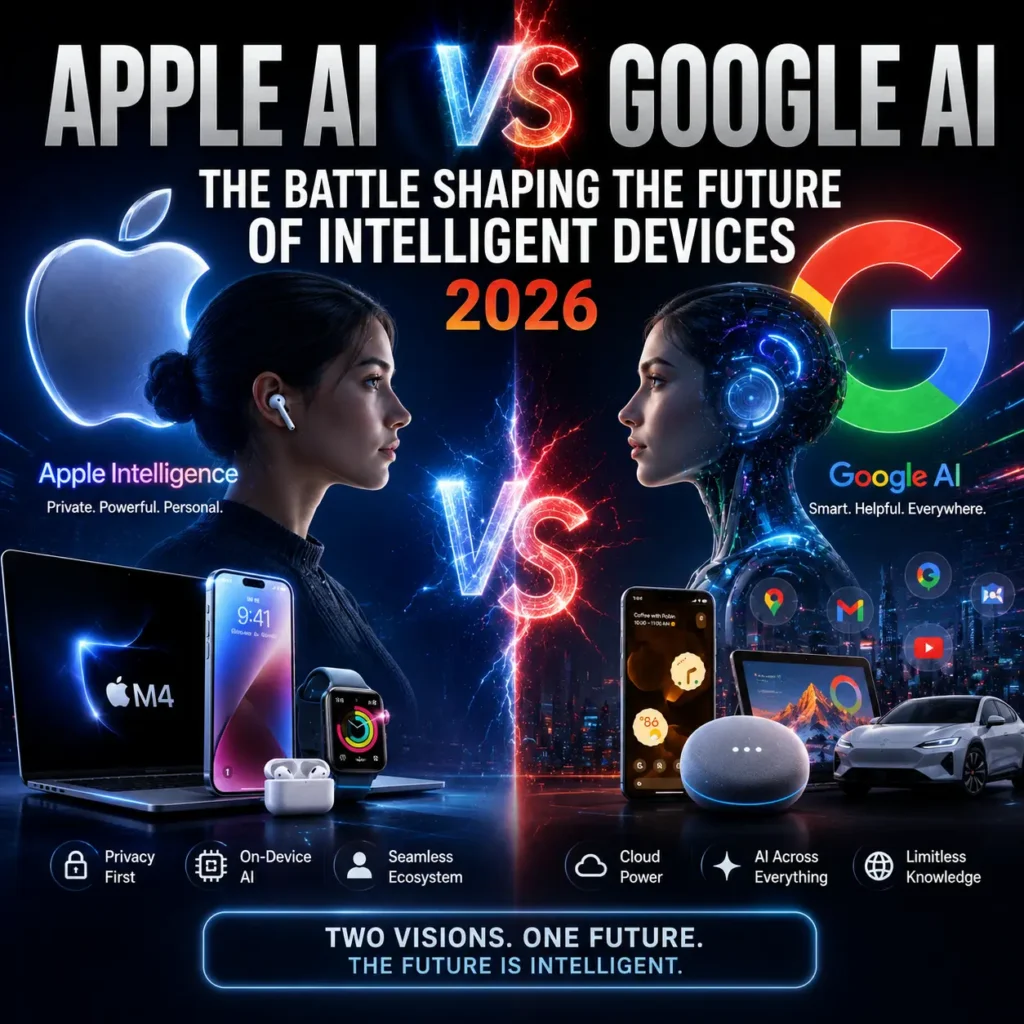
Apple AI vs Google AI: Key Differences
| Feature | Apple Intelligence | Google Gemini |
|---|---|---|
| Core Strategy | Privacy-focused AI | Large-scale AI ecosystem |
| Processing | On-device and private cloud | Primarily cloud-based |
| Integration | Deeply embedded in iOS/macOS | Integrated with Google services |
| AI Capabilities | Contextual assistant tools | Advanced multimodal reasoning |
| Target Users | Apple ecosystem users | Productivity and research users |
Experts often summarize the difference as:
- Apple builds invisible AI integrated into devices.
- Google builds powerful AI platforms accessible everywhere.
Why the Apple vs Google AI Rivalry Matters
The competition between Apple and Google is not just about voice assistants. It represents a broader battle for the future of computing.
AI will increasingly power:
- smartphones
- smart homes
- search engines
- productivity tools
- wearable devices
Google currently leads in AI model development and data scale, while Apple leads in hardware integration and privacy design.
Together, these approaches could redefine how billions of people interact with technology.
The Future of AI in Smartphones
The next generation of smartphones will rely heavily on intelligent assistants capable of understanding context, managing tasks, and generating content automatically.
With Apple Intelligence evolving and Gemini becoming more powerful, we may soon see:
- Fully autonomous AI assistants
- Real-time multimodal search
- AI-powered operating systems
- Personalized digital agents
The real winner in the Apple vs Google AI battle may ultimately be users, who will benefit from faster, smarter, and more personalized devices.
Conclusion
The rivalry between Apple Intelligence and Google Gemini is shaping the next phase of artificial intelligence. Apple’s privacy-focused ecosystem and Google’s powerful AI infrastructure represent two different visions for the future.
Yet the recent partnership between the companies demonstrates that the AI revolution is too large for any single company to dominate alone.
As AI becomes the foundation of modern computing, the competition and collaboration between Apple and Google will determine how billions of people interact with technology in the coming decade.