Agentic AI Is Replacing the Era of Chatbots and Silicon Valley Knows It
For the past three years, the artificial intelligence race has focused on one thing: building larger language models capable of generating text, images, and code. But in 2026, the industry is pivoting toward something far more disruptive.
The new frontier is no longer AI that simply responds.
It is AI that can act.
Across the global technology ecosystem, researchers and major companies are racing to develop what experts now call Agentic AI autonomous systems capable of reasoning, planning, executing tasks, using tools, adapting to feedback, and collaborating with other AI systems without continuous human supervision.
This shift represents the most important evolution in artificial intelligence since the emergence of generative AI itself.
From AI Assistants to Autonomous Workers
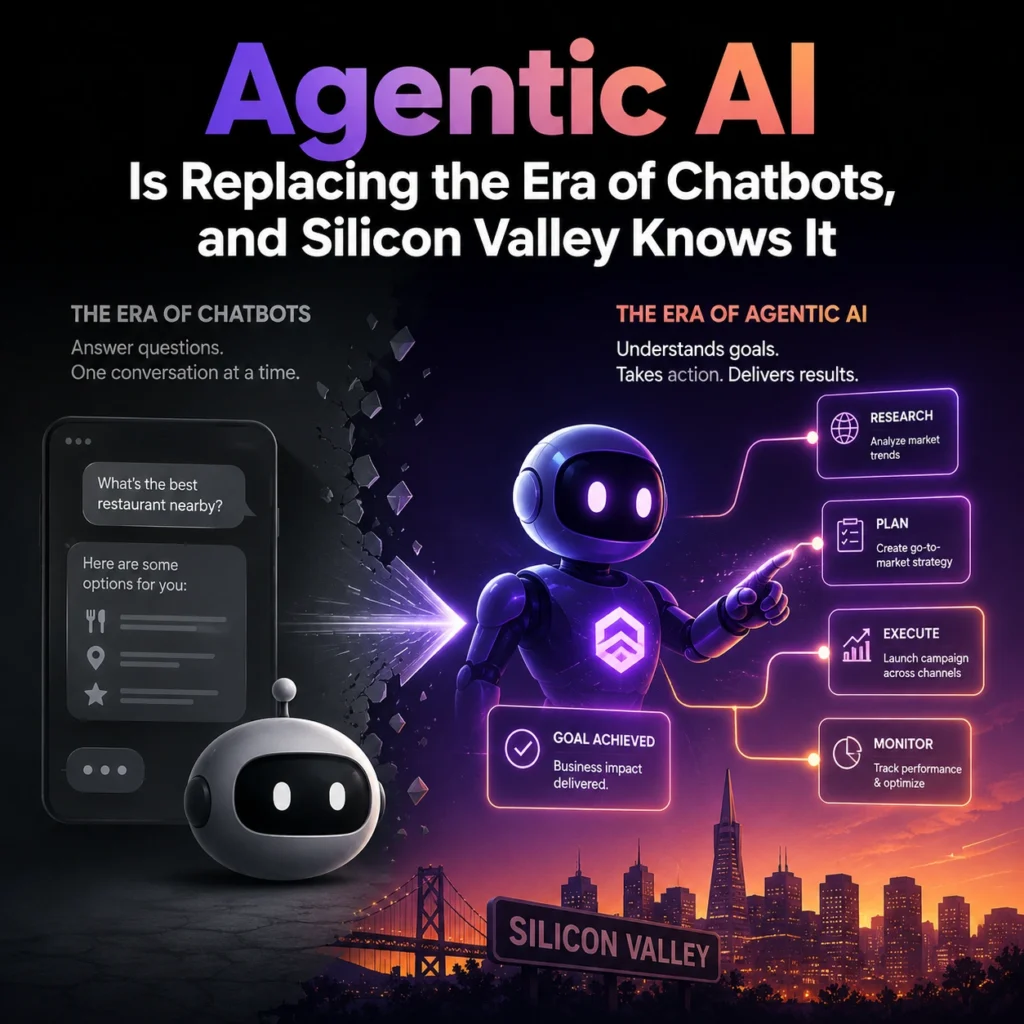
Traditional AI assistants operate reactively. A user submits a prompt, and the model generates a response. Agentic AI changes that relationship entirely.
Instead of waiting for instructions at every step, autonomous AI agents can now:
- Break down complex goals into smaller tasks
- Search the internet and retrieve information
- Write and debug software
- Coordinate with APIs and enterprise tools
- Make decisions based on changing conditions
- Learn from previous outcomes
- Execute multi-step workflows independently
Industry analysts increasingly describe these systems as “digital workers” rather than chatbots.
Major enterprise leaders believe this transition will redefine productivity across finance, healthcare, logistics, cybersecurity, software development, and manufacturing over the next decade.
Goldman Sachs recently described AI agents as a future “digital assembly line,” signaling how rapidly large corporations are integrating autonomous AI into core operations.
Why 2026 Became the Turning Point
Several technological breakthroughs converged at the same time.
- Reasoning Models Became Dramatically Smarter
Modern AI systems are no longer limited to predicting the next word. The newest reasoning-focused architectures are designed to evaluate possibilities, verify outcomes, and simulate decision-making processes before acting.
Companies including OpenAI, Google, and NVIDIA are now investing heavily in models optimized for long-horizon reasoning, autonomous planning, and adaptive execution.
These systems increasingly resemble cognitive operating systems rather than single-purpose models.
- AI Became Multimodal by Default
The newest generation of AI can simultaneously process:
- Text
- Images
- Video
- Audio
- Real-world sensor data
- Live environments
This multimodal capability allows AI agents to interact with both digital and physical environments in real time.
The implications are enormous.
An AI agent can now analyze surveillance footage, understand spoken instructions, monitor operational dashboards, and coordinate robotic systems all within a unified workflow.
- Physical AI Is Entering the Real World
One of the most significant developments in 2026 is the rise of “Physical AI” autonomous systems connected to robotics and real-world machines.
Companies are rapidly deploying intelligent robotic systems capable of:
- Warehouse automation
- Factory operations
- Household assistance
- Surgical support
- Logistics coordination
- Industrial inspection
Instead of relying on rigid programming, these robots learn dynamically through observation, simulation, and reinforcement learning.
Experts increasingly compare modern robotic AI training to how humans learn through experimentation and adaptation.
The New AI Architecture: Systems Instead of Models
The AI industry is quietly abandoning the idea that a single giant model can solve every problem.
Instead, 2026 is defined by multi-agent AI systems.
These architectures combine specialized AI components working together:
- One model handles reasoning
- Another verifies outputs
- Another manages memory
- Another performs planning
- Another enforces safety constraints
This modular approach improves reliability, factual accuracy, adaptability, and long-term task execution.
Researchers increasingly believe this architecture is necessary for achieving advanced autonomous intelligence.
Why Businesses Are Investing Billions
The commercial implications of Agentic AI are staggering.
Unlike earlier AI tools that primarily improved productivity, autonomous agents have the potential to replace entire operational workflows.
Companies are already deploying AI systems for:
- Autonomous customer support
- AI-powered software engineering
- Cybersecurity threat analysis
- Automated financial operations
- Supply chain optimization
- AI research assistants
- Marketing campaign execution
According to multiple industry forecasts, the market for autonomous AI agents could grow into one of the largest software categories of the decade.
For enterprises, the appeal is obvious: AI agents operate continuously, scale instantly, and reduce operational friction across departments.
The Hidden Risk: AI Reliability
Despite the excitement, researchers remain cautious.
Modern AI systems still struggle with:
- Hallucinations
- Poor long-term planning
- Context failures
- Inconsistent reasoning
- Unsafe autonomous actions
That is why a major area of current research focuses on verification systems, memory architectures, and adaptive evaluation benchmarks.
The next phase of AI competition may not be about who builds the biggest model but who builds the most trustworthy autonomous system.
The Beginning of the Autonomous Internet
Many experts now believe Agentic AI could fundamentally reshape the structure of the internet itself.
Instead of humans navigating websites manually, AI agents may increasingly perform tasks on behalf of users:
- Booking travel
- Negotiating prices
- Managing subscriptions
- Researching investments
- Running online businesses
- Coordinating digital workflows
This emerging concept, sometimes described as the “Agentic Web,” could redefine search engines, e-commerce, productivity software, and online advertising.
The interface of the future may no longer be apps and websites.
It may simply be intelligent agents acting on human intent.
Final Thoughts
The AI revolution is no longer about generating content faster.
It is about building systems capable of independent action.
In 2026, the technology industry is transitioning from passive AI assistants to autonomous digital workers capable of reasoning, adapting, and operating across both digital and physical environments.
The companies that master Agentic AI will likely define the next era of global technology leadership.
And for the first time, the question is no longer whether AI can imitate human intelligence.
The question is whether it can operate alongside humans autonomously, continuously, and at a global scale.