Google’s AI Revolution Has Officially Begun, And Apps May Never Be the Same Again
The artificial intelligence industry entered a new era this week.
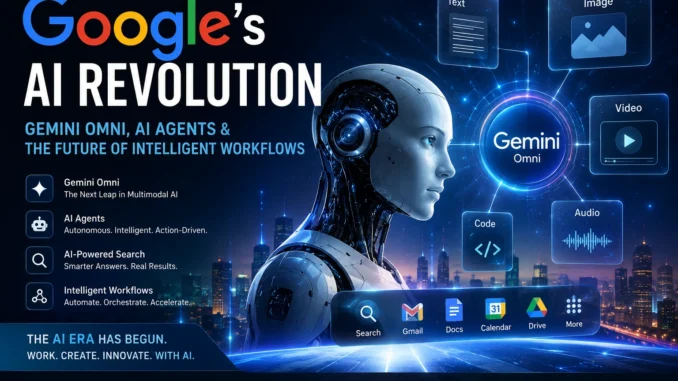
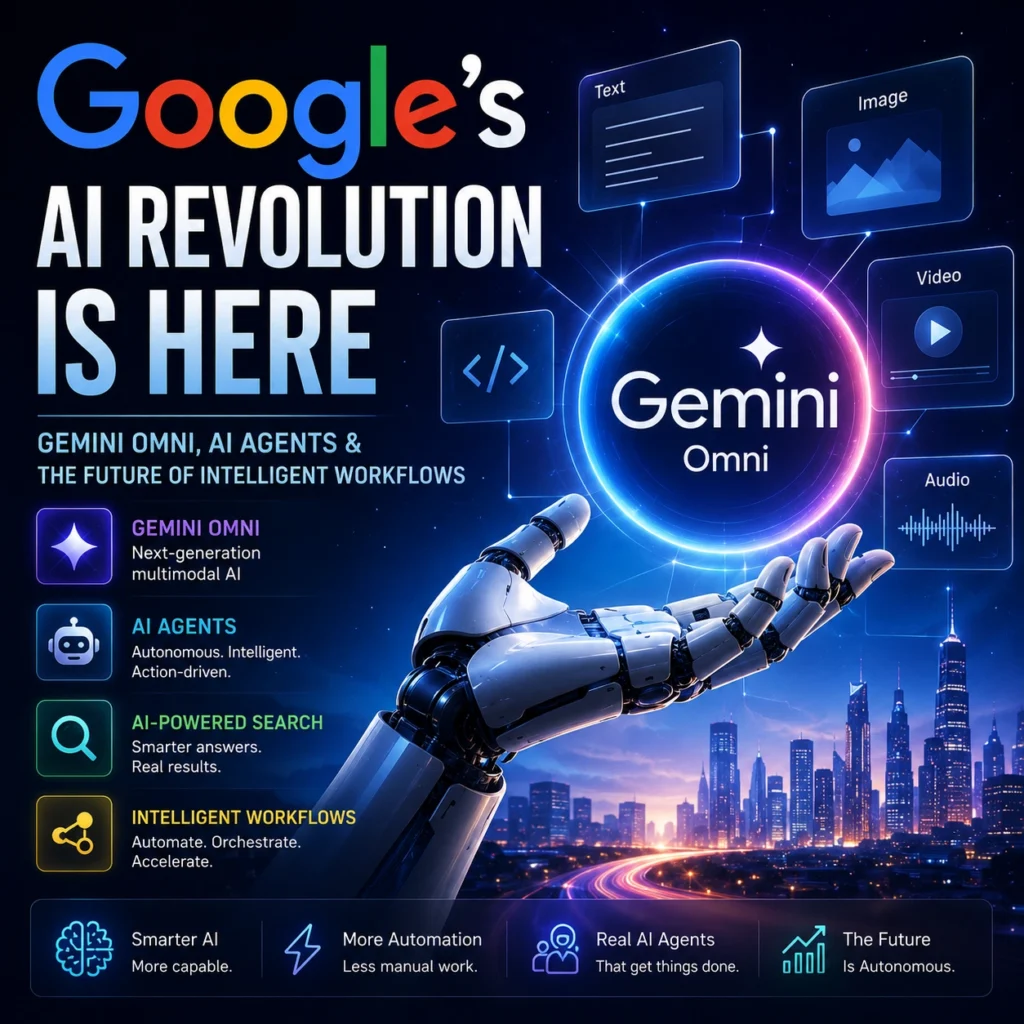
At its 2026 developer conference, Google unveiled a sweeping ecosystem of autonomous AI technologies that signal a dramatic shift away from traditional apps and toward intelligent AI agents capable of completing complex tasks independently. The announcements included Gemini Omni, Gemini Spark, upgraded AI-powered Search, multimodal generation systems, and next-generation workflow automation tools designed to redefine how humans interact with software.
For years, AI assistants responded to prompts. In 2026, they are beginning to act.
The Rise of Agentic AI
The biggest transformation is not simply smarter chatbots it is the emergence of agentic AI systems.
Unlike traditional AI assistants that wait for commands, AI agents can plan, reason, execute tasks, remember context, and interact with multiple tools autonomously. Industry analysts increasingly describe this shift as the beginning of the “post-app internet,” where intelligent systems replace large portions of manual digital workflows.
Google’s newly announced Gemini Spark represents one of the clearest examples yet. The system can integrate with services such as email, calendars, search, documents, and productivity environments to complete actions on behalf of users. Instead of manually opening apps, switching tabs, and managing workflows, users can increasingly delegate those processes directly to AI.
This evolution mirrors broader industry momentum around autonomous systems, enterprise automation, and multimodal AI agents. Recent research and industry reports show rapid growth in systems capable of combining text, audio, video, reasoning, memory, and tool execution into unified AI experiences.
Gemini Omni Pushes Multimodal AI to the Next Level
Another major breakthrough from Google I/O 2026 was the launch of Gemini Omni, a next-generation multimodal AI model capable of generating and understanding text, video, images, audio, and interactive media simultaneously.
This marks a major step toward fully integrated AI creation pipelines.
Previously, creators needed separate tools for:
- Writing scripts
- Generating visuals
- Editing video
- Producing voiceovers
- Managing workflows
Now, advanced multimodal systems can combine those processes into a single AI-driven environment.
The implications for content creation, marketing, media production, education, and software development are enormous. Industry platforms, including Runway, Kling AI, Pippit, and other generative video ecosystems, are already accelerating toward fully autonomous creative workflows.
Google’s move confirms that multimodal AI is no longer experimental technology; it is becoming the foundation of the next internet generation.
AI Search Is Replacing Traditional Browsing
Perhaps the most disruptive announcement was Google’s largest Search overhaul in more than two decades.
The new AI-powered Search experience transforms search engines from simple information retrieval systems into interactive reasoning engines capable of:
- Conducting research
- Summarizing complex topics
- Planning tasks
- Comparing products
- Generating visual dashboards
- Executing workflows
Instead of clicking through dozens of websites, users increasingly receive synthesized answers generated by AI systems.
This transition could dramatically reshape:
- SEO strategies
- Digital publishing
- Affiliate marketing
- Content discovery
- Web traffic distribution
Publishers and creators may soon compete not only for human attention, but also for visibility inside AI-generated responses.
For businesses, the challenge is becoming clear: optimize content for both humans and AI systems simultaneously.
Why AI Agents Could Replace Traditional Apps
The broader industry trend points toward a future where AI agents become the primary interface for computing.
Instead of:
- Opening multiple apps
- Navigating menus
- Performing repetitive actions manually
Users may increasingly rely on intelligent agents capable of understanding goals and executing entire workflows autonomously.
This transformation is already visible across:
- AI coding assistants
- Autonomous research tools
- AI-powered productivity suites
- Marketing automation systems
- Enterprise workflow orchestration
Platforms like CrewAI, AutoGen Studio, LangGraph, and advanced coding agents are rapidly gaining adoption among developers and businesses building autonomous workflows.
The result is a new computing paradigm where software becomes conversational, adaptive, and action-oriented rather than static and interface-driven.
The Enterprise AI Arms Race Intensifies
The announcements also reinforce the escalating competition between major AI companies including OpenAI, Anthropic, Google, NVIDIA, and emerging global AI labs.
The battle is no longer focused solely on chatbot quality. Companies are now competing across:
- Autonomous reasoning
- Multimodal generation
- Real-time agents
- Enterprise integrations
- AI operating systems
- Workflow automation
- On-device AI
- AI infrastructure
Industry reports suggest that businesses adopting agentic AI systems early could gain significant productivity and operational advantages over competitors still relying on conventional software workflows.
The Future of AI in 2026 and Beyond
The AI industry is rapidly moving from:
- Reactive assistants → proactive agents
- Single-input models → multimodal systems
- Static software → autonomous workflows
- Manual productivity → AI orchestration
What began as generative AI is evolving into a fully autonomous digital ecosystem.
The next phase of artificial intelligence will likely center around systems capable of:
- Persistent memory
- Long-term planning
- Multi-step reasoning
- Cross-platform execution
- Human-like contextual understanding
The companies leading this transition may ultimately define the future architecture of the internet itself.
And after Google’s latest announcements, one thing is becoming increasingly clear:
The era of autonomous AI agents has officially arrived.The AI industry is rapidly moving from:
- Reactive assistants → proactive agents
- Single-input models → multimodal systems
- Static software → autonomous workflows
- Manual productivity → AI orchestration
What began as generative AI is evolving into a fully autonomous digital ecosystem.
The next phase of artificial intelligence will likely center around systems capable of:
- Persistent memory
- Long-term planning
- Multi-step reasoning
- Cross-platform execution
- Human-like contextual understanding
The companies leading this transition may ultimately define the future architecture of the internet itself.
And after Google’s latest announcements, one thing is becoming increasingly clear:
The era of autonomous AI agents has officially arrived.