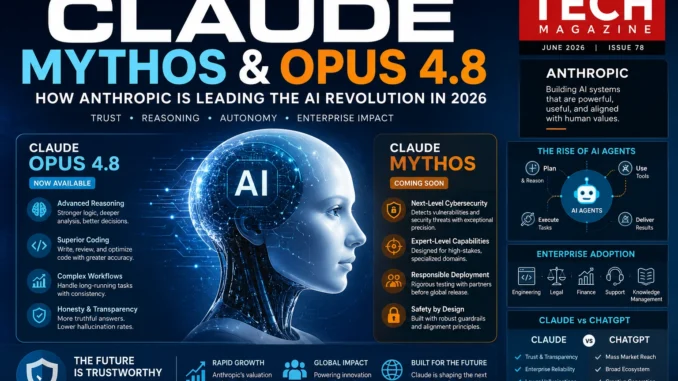
Artificial intelligence is entering a new phase. The race is no longer simply about building the most powerful model; it is about creating AI systems that businesses, developers, and governments can genuinely trust.
In 2026, Anthropic has emerged as one of the most influential companies in this transformation. With the release of Claude Opus 4.8 and the upcoming launch of Claude Mythos, the company is positioning itself at the center of the next generation of AI innovation. Recent reports indicate that Anthropic’s rapid enterprise growth and massive investment rounds have elevated it into the highest ranks of the global AI industry. This momentum is being driven largely by the success of the Claude ecosystem.
The Evolution of Claude AI
Since its launch, Claude AI has been recognized for prioritizing safety, transparency, and reliability. While many AI companies focused on raw performance metrics, Anthropic invested heavily in creating systems capable of delivering accurate, honest, and responsible responses.
The latest generation of Claude models demonstrates how far this strategy has progressed.
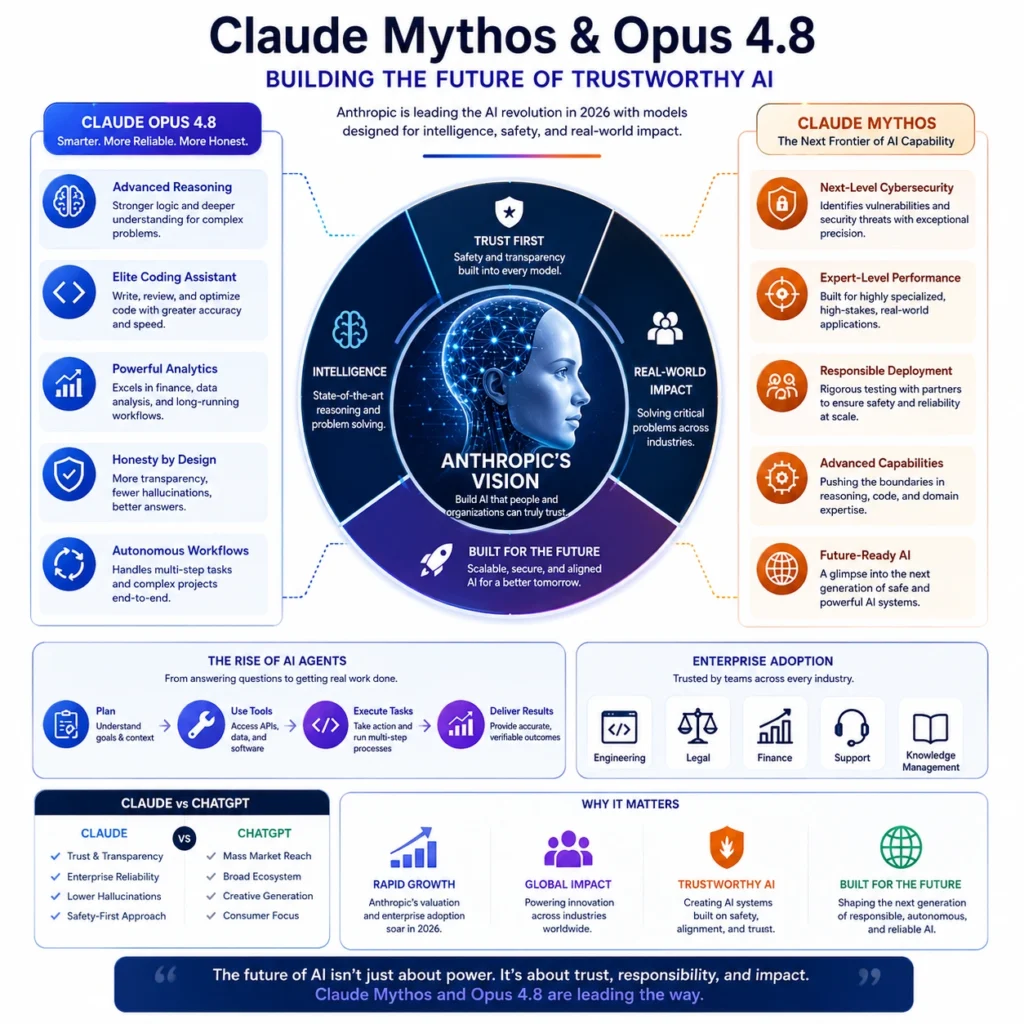
Claude Opus 4.8 introduces significant improvements in:
- Advanced reasoning
- Software development assistance
- Long-running autonomous workflows
- Financial and analytical tasks
- Transparency regarding uncertainty
- Reduced hallucination rates
According to Anthropic, Opus 4.8 is specifically designed to provide more honest answers when information is uncertain rather than generating overly confident but incorrect responses. This addresses one of the most persistent challenges facing modern AI systems.
Why Trustworthy AI Matters
As AI becomes integrated into healthcare, finance, law, cybersecurity, and government operations, trust is becoming a competitive advantage.
Organizations increasingly need AI systems capable of:
- Explaining their reasoning
- Identifying uncertainty
- Maintaining consistency across long tasks
- Reducing factual errors
- Operating safely in sensitive environments
Anthropic’s philosophy is centered around these requirements.
Rather than treating safety as a secondary feature, the company integrates safety principles directly into model development. This approach has attracted substantial interest from enterprises seeking dependable AI solutions.
Claude Mythos: The Next Frontier
Perhaps the most anticipated development is Claude Mythos.
Although not yet broadly available, Mythos has already attracted significant attention due to reports of its advanced cybersecurity capabilities. Early testing suggests that the model can identify software vulnerabilities at a level previously unseen in commercial AI systems.
Anthropic has reportedly chosen a cautious deployment strategy, collaborating with major technology companies and security organizations before making the model widely accessible.
This decision highlights a broader industry shift: powerful AI capabilities increasingly require responsible release strategies.
The significance of Mythos extends beyond cybersecurity.
Industry analysts view it as a glimpse into the future of AI systems capable of performing highly specialized expert-level tasks while maintaining rigorous safety controls.
Claude and the Rise of AI Agents
Another major trend shaping the technology landscape is the emergence of AI agents.
Traditional chatbots respond to questions. AI agents actively perform tasks.
Claude’s architecture has evolved to support:
- Complex project management
- Autonomous coding workflows
- Multi-step reasoning
- Tool integration
- Extended task execution
For developers, this means AI can increasingly function as a collaborative partner rather than a simple assistant.
The growth of Claude Code and enterprise integrations demonstrates how organizations are beginning to leverage AI agents to accelerate productivity and innovation.
Enterprise Adoption Accelerates
One of the clearest indicators of Claude’s success is its enterprise adoption.
Businesses are increasingly deploying Claude across:
- Software engineering teams
- Legal research departments
- Financial analysis groups
- Customer support operations
- Knowledge management systems
Anthropic has expanded its professional ecosystem through integrations with enterprise software providers, allowing organizations to securely connect Claude with proprietary data and workflows.
This strategy has helped transform Claude from a standalone chatbot into a comprehensive AI platform.
Claude vs ChatGPT: The 2026 Landscape
The competition between Anthropic and OpenAI remains one of the defining stories of the AI industry.
While ChatGPT continues to dominate consumer awareness, Claude has gained substantial momentum among enterprise customers and developers.
The distinction is becoming increasingly clear:
- OpenAI focuses on broad AI ecosystems and consumer reach.
- Anthropic emphasizes trustworthiness, transparency, and enterprise reliability.
Both strategies are succeeding, but Claude’s rapid growth demonstrates that businesses are willing to invest heavily in AI systems designed specifically for professional environments.
What Comes Next?
The future of AI will likely be defined by three key factors:
- Reliability
- Autonomy
- Trust
Claude Opus 4.8 and the upcoming Claude Mythos suggest that Anthropic is building its roadmap around all three.
As organizations continue integrating AI into mission-critical workflows, the winners of the AI race may not simply be the companies with the most powerful models. Instead, they may be the companies that create AI systems people are willing to trust with their most important decisions.
Anthropic’s recent advances indicate that trustworthy AI is no longer a niche concept; it is rapidly becoming the foundation of the next generation of artificial intelligence.
The arrival of Claude Mythos and Opus 4.8 may ultimately be remembered as a turning point in that transformation.