Artificial Intelligence has spent the last few years learning how to answer questions. In 2026, Google is betting that AI should do much more than respond; it should act.
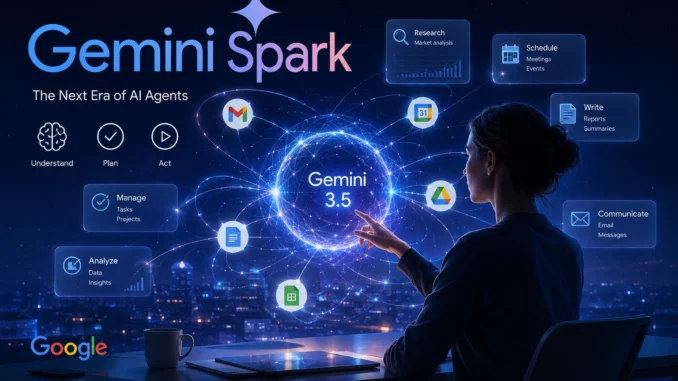
At Google I/O 2026, Google unveiled one of the most significant advancements in consumer AI since the emergence of large language models: Gemini Spark, a proactive AI agent designed to work continuously on behalf of users. Rather than waiting for prompts, Gemini Spark represents a new generation of intelligent systems capable of planning, monitoring, researching, and executing tasks across digital environments.
This evolution signals a major shift in the AI industry. The competition is no longer about building smarter chatbots. The race is now focused on creating autonomous AI agents that can become true digital assistants.
From Chatbot to Digital Agent
Traditional AI assistants operate reactively. Users ask questions, and the system responds.
Gemini Spark changes that model completely.
Google describes Spark as an always-on AI agent that can interact with connected services, analyze information, monitor ongoing activities, and complete complex workflows with minimal user intervention. The technology is deeply integrated with Google’s ecosystem, including Gmail, Calendar, Docs, Search, and Workspace applications.
Imagine asking an AI not simply to find information about a conference, but to monitor registration updates, compare travel options, schedule meetings, summarize research materials, and prepare a complete itinerary automatically.
That is the future Google is building.
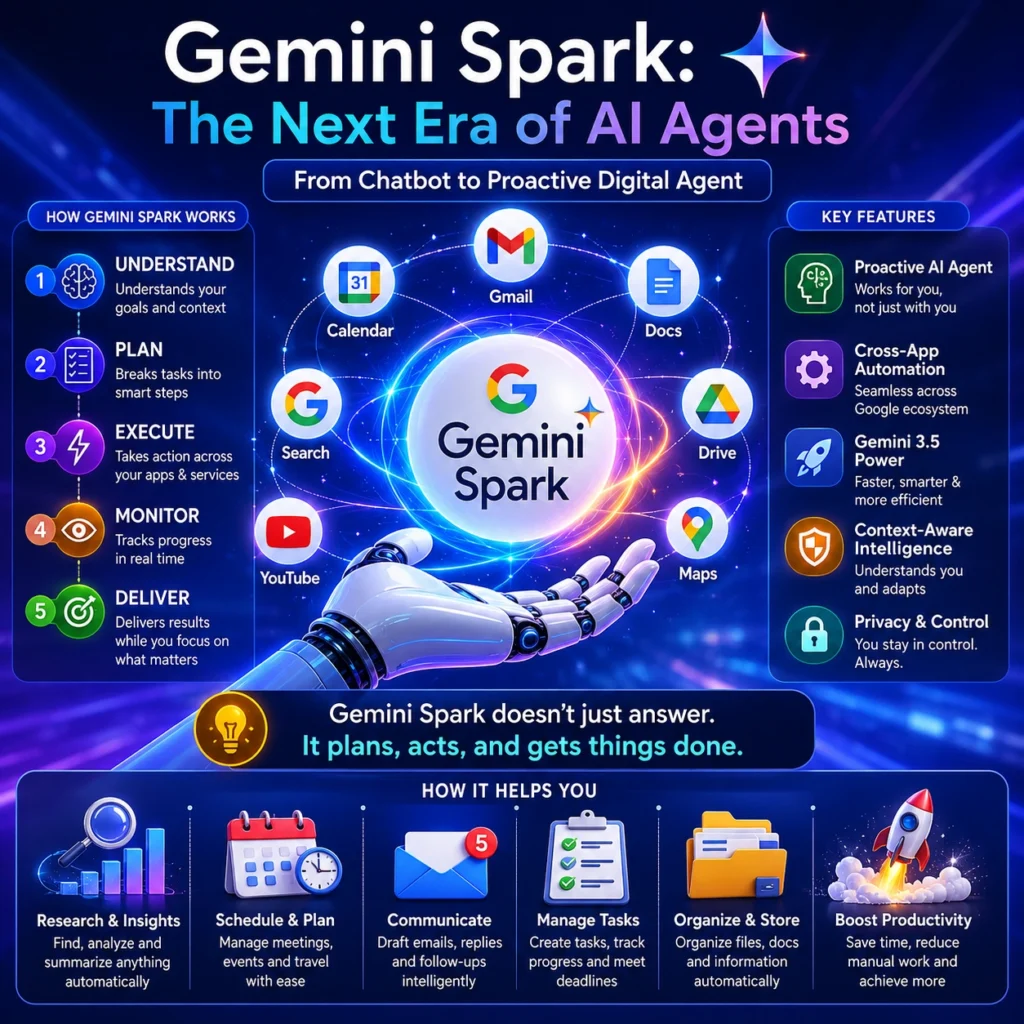
Why Gemini Spark Matters
The significance of Gemini Spark extends beyond productivity.
For years, AI tools have reduced the time required to generate content, answer questions, and perform research. However, human users still needed to manage the overall process.
Agentic AI changes this equation.
Gemini Spark introduces a workflow model where users focus on goals while AI handles execution. This approach has the potential to reshape how professionals, entrepreneurs, students, and organizations interact with technology.
Instead of searching, filtering, organizing, and acting manually, users can delegate entire processes to intelligent agents.
The result is a fundamental shift from information retrieval to intelligent task completion.
Gemini 3.5: The Engine Behind the Transformation
Powering many of these capabilities is Google’s new Gemini 3.5 family of models.
Google introduced Gemini 3.5 Flash as a faster and more efficient model designed specifically for real-world actions and long-running tasks. The company positions it as a major advancement in agentic AI, combining reasoning, execution, and efficiency within a single architecture.
One of Google’s primary goals is to reduce AI operational costs while improving performance. This becomes increasingly important as organizations deploy AI agents at scale across customer service, operations, software development, research, and knowledge management.
Gemini 3.5 is designed to provide the intelligence necessary for autonomous systems while maintaining practical operating costs.
The Rise of Personal AI Operating Systems
One of the most interesting implications of Gemini Spark is the emergence of what many analysts describe as a personal AI operating system.
Rather than opening separate applications for email, calendars, documents, research, and planning, users may increasingly rely on a single AI layer that orchestrates all digital interactions.
This creates a radically different computing experience.
The interface becomes conversational.
The AI becomes contextual.
The workflow becomes autonomous.
Google’s vision suggests a future where users spend less time navigating software and more time communicating objectives.
How Gemini Could Transform Businesses
For businesses, the impact could be substantial.
Organizations are already experimenting with AI-powered customer support, workflow automation, content generation, and analytics. Gemini Spark extends these capabilities by introducing persistent AI agents capable of operating continuously.
Potential applications include:
- Automated market intelligence monitoring
- Competitive research and reporting
- Customer communication management
- Project coordination
- Meeting preparation and summarization
- Sales pipeline tracking
- Knowledge management automation
Companies adopting agentic AI early may gain significant productivity advantages as routine digital work becomes increasingly automated.
Challenges and Concerns
Despite the excitement, the rise of autonomous AI introduces important questions.
Privacy remains a central concern. To function effectively, AI agents often require access to emails, calendars, documents, and other sensitive information.
There are also concerns regarding transparency, reliability, and decision-making authority. Users must understand how AI agents reach conclusions and what actions they are permitted to perform.
Google emphasizes that users remain in control, but the balance between automation and oversight will become a defining issue for the next generation of AI products.
The Beginning of the Agent Era
It marks the beginning of a new phase in artificial intelligence where systems move beyond conversation and become active participants in digital work.
The AI industry’s next battleground is not who can answer questions most effectively. It is who can build the most capable, trustworthy, and useful AI agents.
With Gemini Spark, Google has made it clear that it intends to lead that race.
As AI continues evolving throughout 2026 and beyond, the transition from chatbot to autonomous digital agent may prove to be one of the most important technological shifts of the decade.
The future of productivity is no longer about interacting with software.
It is about collaborating with intelligent systems that work alongside us.