The AI Video Generation Revolution Has Officially Begun
The AI industry is entering a new era where creating cinematic videos no longer requires expensive cameras, production teams, or advanced editing expertise. In 2026, AI video generation tools have evolved from experimental software into professional creative platforms capable of producing stunning, hyper-realistic, and commercially viable content within minutes.
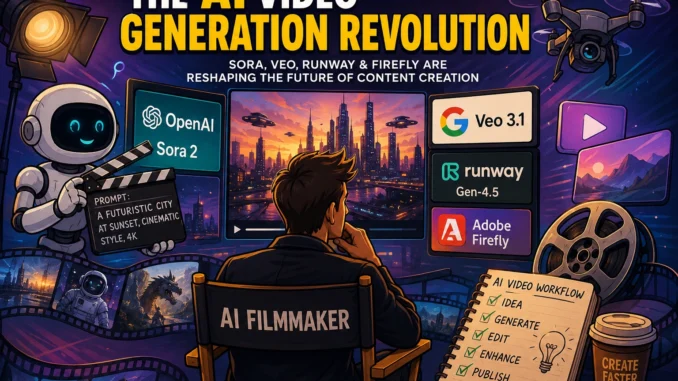
What started with simple text-to-image generators has rapidly transformed into a fierce competition between tech giants and AI startups. Today, companies like OpenAI, Google, Adobe, and Runway are racing to dominate the future of AI-powered filmmaking.
The result is an explosion of tools capable of generating cinematic scenes, synchronized audio, advanced visual effects, character consistency, and realistic physics, all from a simple text prompt.
Industry analysts now believe AI video creation may become one of the largest segments of the generative AI economy over the next few years. Major investments, new model releases, and integration into professional editing software are accelerating the transition from traditional production workflows to AI-first content pipelines.
Why AI Video Generation Is Exploding in 2026
Several breakthroughs have pushed AI video tools into the mainstream:
- Dramatic improvements in motion realism
- Native audio and lip-sync generation
- Better character consistency across scenes
- Faster rendering speeds
- Integration with professional editing suites
- Lower production costs for creators and businesses
Unlike early AI videos that looked unstable or surreal, modern systems can now produce cinematic camera movements, realistic lighting, coherent storytelling, and even emotionally expressive characters.
According to multiple industry comparisons and testing reports, the latest generation of AI video models now competes with traditional video production for certain types of marketing, social media, advertising, and entertainment content.
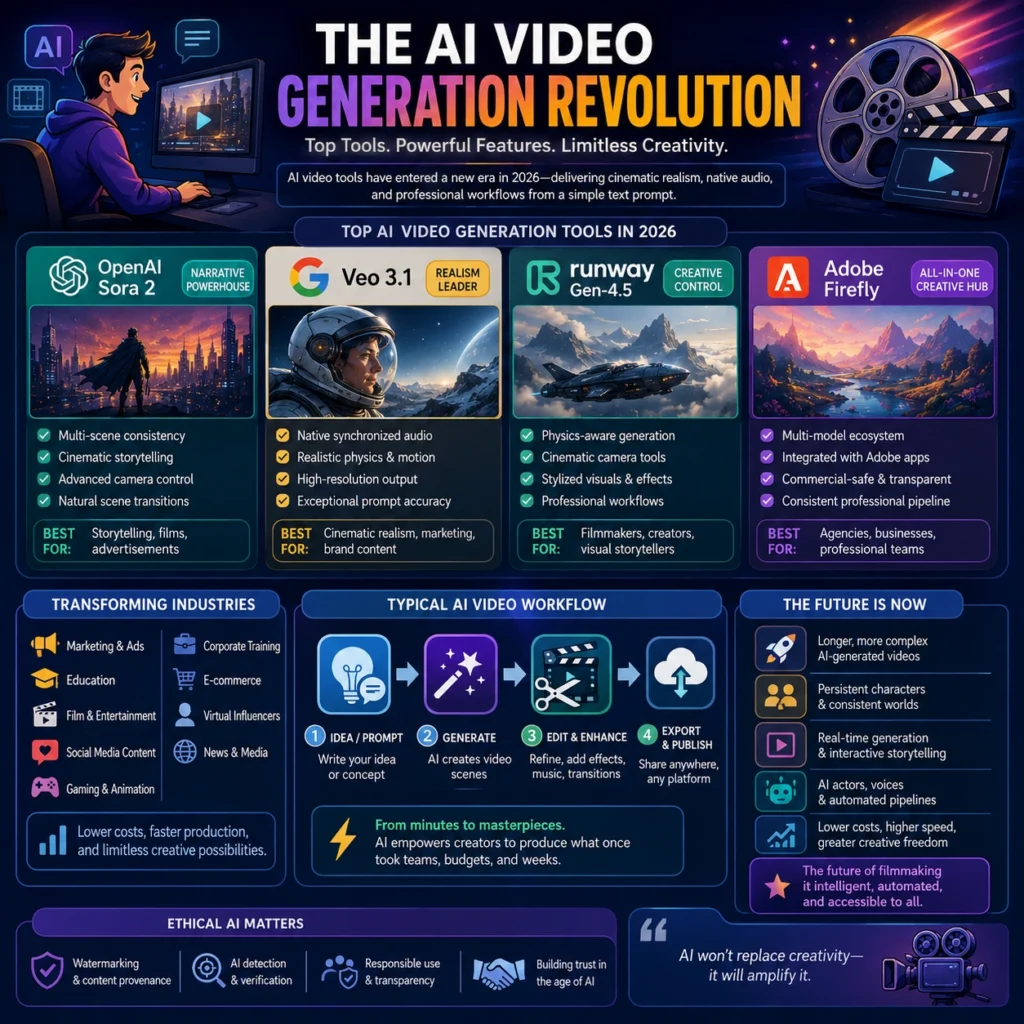
The Biggest AI Video Generation Tools Dominating 2026
OpenAI Sora 2: AI Storytelling Becomes Cinematic
OpenAI shocked the technology world when it introduced Sora, but the latest evolution, Sora 2, has pushed AI storytelling to another level.
Sora 2 focuses heavily on:
- Multi-scene consistency
- Realistic environmental motion
- Cinematic storytelling
- Camera choreography
- Natural scene transitions
One of its biggest strengths is maintaining continuity between shots, making it especially attractive for filmmakers, advertisers, and digital storytellers.
Industry comparisons suggest Sora 2 performs exceptionally well for narrative-driven projects and immersive visual storytelling.
However, the market is evolving rapidly, and some reports indicate OpenAI may shift toward integrating video generation directly into broader AI ecosystems instead of maintaining standalone consumer video products.
Google Veo 3.1: The Rise of Hyper-Realistic AI Cinema
Google has aggressively entered the AI video race with Veo 3.1, which many reviewers now consider one of the most realistic AI video models available.
The platform stands out for:
- Native synchronized audio
- Exceptional physics simulation
- High-resolution cinematic output
- Advanced prompt accuracy
- Realistic human movement
Some independent testing platforms describe Veo 3.1 as the new benchmark for cinematic AI video quality.
Google is also expanding beyond traditional generation tools with projects like Gemini Omni, which allows creators to transform text, photos, and videos into realistic AI-generated clips while maintaining subject consistency.
This shift indicates a broader trend: future AI video systems will likely become “anything-to-video” creative engines rather than isolated text-to-video tools.
Runway Gen-4.5: Hollywood-Style AI Production
Runway remains one of the most influential startups in the AI filmmaking industry.
Its latest model, Runway Gen-4.5, is widely praised for:
- Physics-aware motion
- Cinematic camera control
- Stylized visual effects
- Professional editing workflows
- Production-ready outputs
Runway has become particularly popular among creators who want more artistic control rather than fully automated generation.
The company’s rapid growth has attracted major investor attention. Recent funding reports valued Runway at billions of dollars as demand for AI video infrastructure continues to grow.
Adobe has even integrated Runway directly into Firefly, allowing creators to combine multiple AI models inside one professional workflow.
Adobe Firefly: The AI Creative Hub Strategy
Adobe is taking a different approach from most AI companies.
Instead of focusing on a single AI model, Adobe is transforming Firefly into a centralized AI creativity platform that combines multiple leading video generation systems.
Firefly now integrates:
- Google Veo 3.1
- Runway Gen-4.5
- Kling AI
- Adobe’s own Firefly models
- Additional third-party AI systems
This “multi-model ecosystem” strategy allows creators to select the best AI engine for each creative task.
Adobe is also emphasizing commercial safety, copyright transparency, and seamless integration with creative tools like Premiere Pro and After Effects.
For businesses and agencies, this may become one of the safest and most scalable AI production environments available.
AI Video Generation Is Changing Entire Industries
The impact of AI video generation now extends far beyond entertainment.
Industries already being transformed include:
- Digital marketing
- Social media content creation
- Online education
- Film production
- Advertising
- Gaming
- Virtual influencers
- Corporate training
- E-commerce
Companies can now generate promotional videos, cinematic advertisements, product demos, and localized multilingual campaigns at a fraction of traditional production costs.
Creators who once needed large budgets can now build professional-quality visual content using only AI tools and creative prompts.
This democratization of filmmaking may become one of the largest disruptions in the history of digital media.
The Growing Ethical Concerns Around AI Video
As AI-generated videos become increasingly realistic, concerns about misinformation and deepfakes are also intensifying.
New research highlights the growing difficulty of distinguishing AI-generated media from authentic footage. Researchers are now developing advanced detection systems designed to identify synthetic video content across multiple platforms.
Technology companies are responding with:
- Watermarking systems
- Content authentication tools
- AI detection research
- Safety restrictions
- Transparency initiatives
Google’s SynthID and Adobe’s Content Credentials are examples of efforts to establish trust in AI-generated media.
Still, the rapid improvement of AI realism suggests the internet may soon enter an era where verifying video authenticity becomes significantly more difficult.
The Future of AI Filmmaking
The next generation of AI video tools is expected to introduce:
- Longer cinematic sequences
- Persistent AI characters
- Real-time video generation
- Interactive storytelling
- AI-generated actors
- Fully autonomous video production pipelines
Researchers are also working on dramatically reducing computational costs while improving generation speed and realism.
Meanwhile, the boundary between video generation, editing, animation, and virtual production is rapidly disappearing.
The future may not belong to traditional editing software alone; it may belong to intelligent creative systems capable of generating entire multimedia experiences from a single idea.
Finaly
AI video generation in 2026 is no longer a futuristic concept; it is becoming a core part of the global content economy.
The competition between OpenAI, Google, Adobe, and Runway is accelerating innovation at an unprecedented pace.
For creators, businesses, filmmakers, and marketers, the message is clear:
The future of video production is increasingly AI-driven, faster, cheaper, and more accessible than ever before.
Those who adapt early may gain a massive advantage in the next generation of digital media.
Sources & Further Reading
- OpenAI Official announcements and research related to generative AI and video generation technologies.
- Google DeepMind Updates on Gemini, Veo, and multimodal AI video research.
- Runway AI Official platform for Runway Gen-4.5 and AI filmmaking tools.
- Adobe Firefly: Adobe’s AI creative ecosystem for image and video generation.
- Synthesia AI avatar and enterprise video creation platform.
- HeyGen AI avatar and multilingual video generation system.