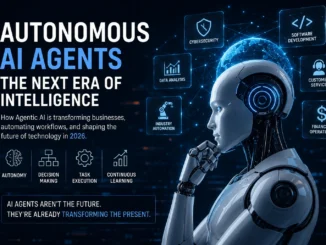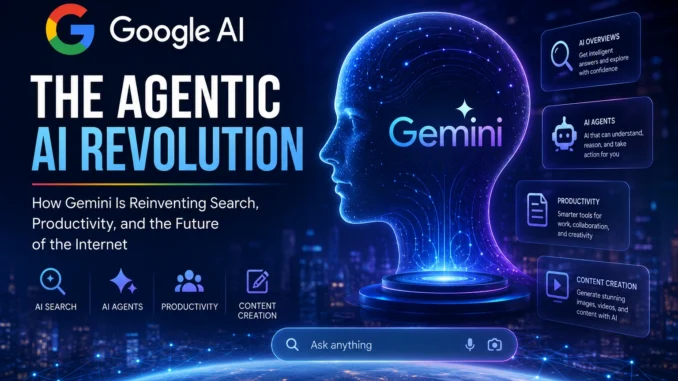
Google’s Agentic The Biggest Transformation Since the Birth of Search
For more than two decades, Google has defined how humanity accesses information. Every major technological shift from mobile computing to cloud infrastructure has eventually flowed through Google’s ecosystem.
Now, the company is attempting something even bigger.
In 2026, Google is no longer positioning artificial intelligence as a feature. AI has become the foundation of its entire product strategy. From Search and Android to Workspace and content creation tools, Google’s Gemini ecosystem is evolving into an intelligent layer that can understand, reason, create, and take action.
The result is a dramatic transformation that could reshape how billions of people interact with the internet.
From Search Engine to AI Agent
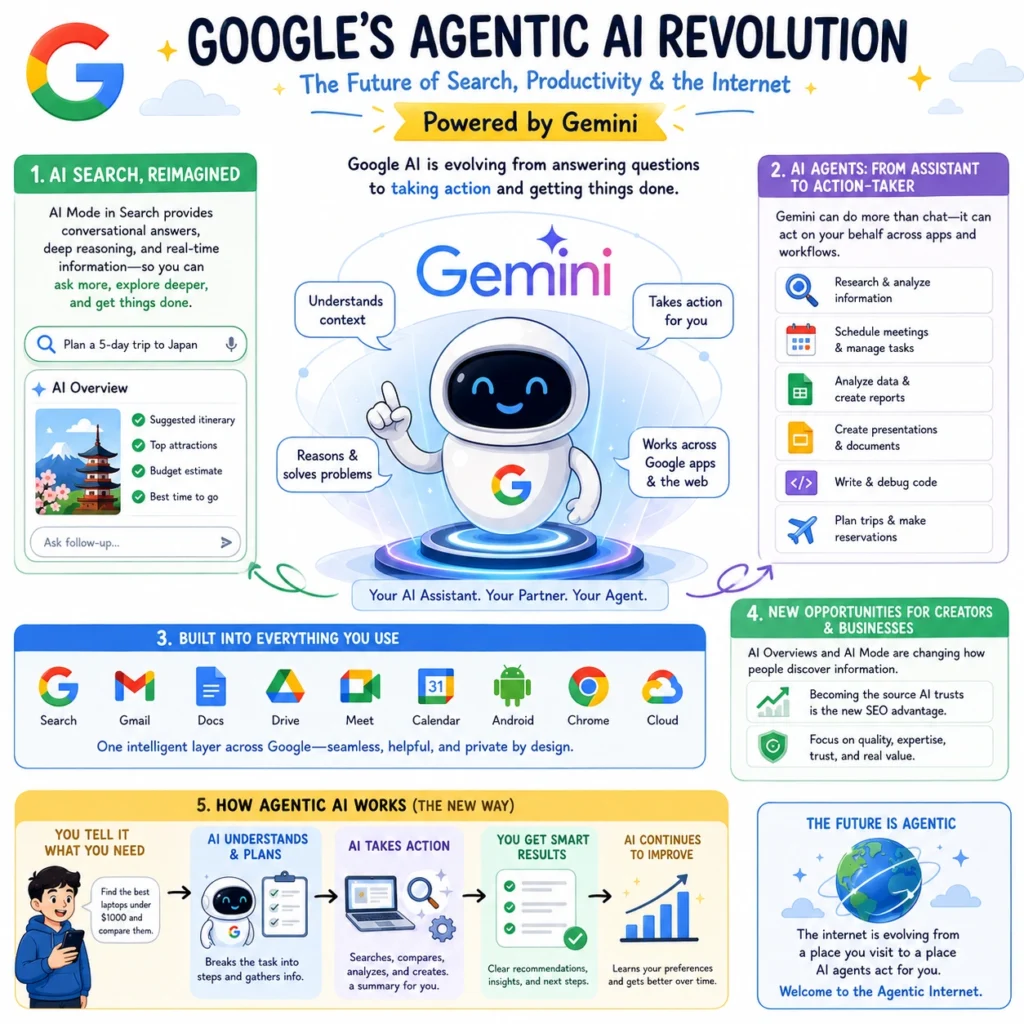
The most important announcement emerging from Google’s latest AI strategy is the evolution of Search itself.
Historically, Google Search worked by displaying links and allowing users to navigate through websites. While this model built one of the most successful companies in history, user expectations have changed dramatically in the age of generative AI.
Google’s new AI Mode introduces conversational search experiences powered by Gemini. Instead of providing a list of pages, Search increasingly delivers synthesized answers, contextual reasoning, follow-up conversations, and direct task execution.
This marks the biggest redesign of Google Search in over 25 years.
Users can now ask complex, multi-step questions, receive structured responses, and continue refining queries naturally without restarting the search process.
The implications are enormous.
Search is no longer becoming a destination for information.
It is becoming an intelligent assistant.
Gemini: The Brain Behind Google’s AI Ecosystem
At the center of Google’s strategy sits Gemini, the company’s flagship AI model family.
Recent updates have pushed Gemini beyond traditional chatbot capabilities into what Google calls an “agentic” future.
Unlike earlier AI systems that simply generate text, modern Gemini models are being designed to understand context, reason through problems, interact with software, and complete tasks autonomously.
The newest generation of Gemini models introduces stronger reasoning abilities, larger context windows, advanced multimodal understanding, and deeper integrations across Google’s products.
For businesses and developers, this means AI systems that can process documents, analyze data, generate code, understand images, interact with applications, and coordinate workflows with minimal human intervention.
Google is effectively building a universal AI operating system.
The Rise of AI Agents
One of the most fascinating developments in Google’s roadmap is the emergence of AI agents.
These systems move beyond simple conversation and begin acting on behalf of users.
Imagine asking an AI assistant to:
- Research competitors
- Compare products
- Draft reports
- Schedule meetings
- Analyze spreadsheets
- Create presentations
- Monitor projects
- Execute software workflows
Instead of manually navigating dozens of applications, users increasingly describe objectives while AI systems handle execution.
Google executives describe today’s AI agents as the early stages of a much larger technological transition.
This vision aligns with growing industry expectations that autonomous AI systems will become a primary interface for digital work over the next decade.
AI Search Is Reshaping SEO Forever
Perhaps no industry is feeling the impact more intensely than digital publishing and search engine optimization.
AI Overviews and AI Mode are changing how information is discovered online.
Instead of sending users directly to websites, AI systems increasingly summarize content within search results themselves.
This creates both opportunities and challenges.
Publishers with authoritative content may gain visibility through AI citations, while traditional click-through traffic patterns continue to evolve.
For SEO professionals, success is no longer solely about ranking pages.
The new objective is to become AI visibility.
Brands must optimize for entity authority, expertise, trustworthiness, topical depth, and factual accuracy if they want AI systems to reference their content.
The next generation of search optimization will likely focus on becoming the source that AI trusts.
Gemini and the Future of Content Creation
Google is also accelerating its push into AI-powered media generation.
Text, images, audio, and video are increasingly converging into unified creative workflows.
Modern Gemini-powered tools can generate visual content, assist with video production, create marketing assets, and support creators through conversational interfaces.
The company’s long-term goal appears clear:
Transform content creation from a complex technical process into a natural conversation.
Creators will increasingly describe what they want, while AI systems generate and refine the output.
This could significantly reduce production costs while dramatically increasing creative speed.
Why Google’s AI Strategy Matters
The AI race is often framed as a competition between major technology companies.
However, Google’s position remains unique.
Few organizations possess:
- The world’s largest search ecosystem
- Massive cloud infrastructure
- Billions of active users
- Deep AI research expertise
- Proprietary data ecosystems
- Global developer adoption
These advantages create a powerful foundation for deploying AI at unprecedented scale.
As AI becomes embedded across products used by billions of people, Google’s influence over the next generation of digital experiences could become even greater than during the mobile revolution.
The Beginning of the Agentic Internet
The internet is entering a new era.
For decades, users interacted directly with websites, applications, and search engines.
The next phase may look fundamentally different.
Instead of navigating digital environments manually, people will increasingly rely on intelligent AI agents capable of understanding goals and executing tasks autonomously.
Google’s Gemini ecosystem represents one of the clearest visions of this future.
Whether through AI Search, autonomous assistants, multimodal content creation, or intelligent productivity tools, the company is positioning itself at the center of an emerging agent-driven internet.
The transformation has only begun.
But one thing is becoming increasingly clear:
The future of the web may not be built around websites.
It may be built around AI.